National Guidelines on Diversion from Prosecution in Scotland
These guidelines provide an overview of Diversion from Prosecution (DfP) in Scotland, and the roles and responsibilities of the relevant agencies involved.

Introduction
These guidelines provide an overview of Diversion from Prosecution (DfP) in Scotland, and the roles and responsibilities of the relevant agencies involved.
This version of the guidelines reflects the recommendations from the Inspectorates’ Joint Review of Diversion from Prosecution [1].
DfP is a process by which the Procurator Fiscal [2] refers a person to their Local Authority as a means of addressing the underlying causes of alleged offending behaviour. This can be done instead of commencing a court proceeding (or before a final decision is taken in relation to court proceedings).
DfP is one of a range of direct measures which are available to the Procurator Fiscal[4]. Which measure is used will depend on the facts and circumstances of each case and what prosecutors consider to be in the public interest.
The aims of DfP are: To deliver an effective and prompt intervention which can address the causes of alleged offending behaviour.
This approach will promote the public interest of rehabilitation; prevent further offending behaviour; and provide victims of crime and the public with reassurance that any offending behaviour has been addressed.
The benefits of a successful DfP are that it:
- Provides the person with an opportunity to obtain support to deal with any issues or needs that may have contributed to the alleged offending behaviour.
- Provide early intervention to reduce likelihood of further offending behaviour.
- Provides a swift resolution and reduces contact with the criminal justice system for all involved.
- Prevents stigmatisation of the person, by avoiding a criminal conviction which may impact on life chances.
General Approach
DfP should be person-specific, and all partners, where appropriate, should take into account a person’s learning disabilities, and/or neurodiversity, the existence of any speech and communication needs including any literacy or interpretation needs, as well as taking an age-appropriate approach.
All partners should take a trauma informed approach meaning that, they should be aware of the impact of trauma and adapt how they engage with a person so that the impact of trauma does not create a barrier to an effective intervention[5].
In exercising their respective roles, all partners should consider the impact of alleged offending behaviour on any victim of crime.
Police officers have a crucial role in identifying, at the outset if DfP is likely to be appropriate.
When reporting the case to the Procurator Fiscal, police officers should note in the Standard Prosecution Report (SPR), where known, whether the accused has any identifiable needs. For example (but not limited to):
- A physical / mental health need
- A dependency-type need (e.g. drugs, alcohol, gambling, etc.)
- A learning disability and/or communication support needs
- Experience of deprivation/neglect
- Welfare needs (for example, homelessness)
Police officers should also include a summary of relevant information relating the person on the Interim Vulnerable Persons’ Database (IVPD), as well as information about the person’s:
- Attitude to alleged offending behaviour
- Peer interactions/family dynamics
- Caring responsibilities
- Employment/training
Police officers must highlight in the SPR if the person has any literacy or interpretation needs which may affect the way the Procurator Fiscal or Local Authority communicates with them.
Police officers should be aware of what DfP is, and that it may be a potential outcome in any case and may raise this possibility in discussions with victims of crime.
Police officers should provide information on the impact of alleged offending on any victim(s) of crime and any views in relation to the potential use of DfP where known.
Police officers may provide a view in the SPR on the potential suitability of a person for DfP based on their knowledge of the incident and/or the person.
The Lord Advocate determines prosecution policy independently[6].
Prosecution policy is that DfP will be considered in all cases where a person is reported to the Procurator Fiscal, where the person has an identifiable need[7] that may have contributed to the alleged offending and may be offered when this is deemed the most appropriate course of action in the public interest[8].
In general, the more serious the case the less likely that DfP will be appropriate in the public interest and prosecutors will consider any specific instructions from the Lord Advocate in relation to the marking of cases.
For children (under 18) there is a rebuttable presumption that an alternative to prosecution will be in the public interest. This can include DfP, as can referral to the Children’s Reporter where possible.
Decision making
Procurators Fiscal will consider all information provided in the SPR. Where necessary, the Procurator Fiscal will seek further information and/or clarification on any aspect of the information available to them.
As set out in the Prosecution Code, the Procurator Fiscal will assess whether there is a sufficiency of evidence, and what prosecutorial action, if any, is in the public interest.
Whilst DfP does not represent a criminal conviction or a finding of guilt, there must be sufficient corroborated evidence available to support a prosecution before the Procurator Fiscal can refer a person for consideration of DfP.
In deciding whether a person may be suitable for DfP, the Procurator Fiscal will assess the facts and circumstances of each case in line with the Prosecution Code. This will include the nature of the alleged offending behaviour and the impact the behaviour had on any victim(s) of crime.
Where relevant, the views of any victim of crime, where known, will be considered alongside the other public interest considerations set out in Prosecution Code.
Where the Procurator Fiscal is satisfied that the public interest would be best served by an offer of DfP they will write to the person and advise that arrangements are being made for a suitability assessment to be undertaken by the Local Authority.
Model of diversion
The Procurator Fiscal will also decide if the DfP should follow the deferred or waived prosecution model.
In the waived model, the decision not to prosecute is taken at the outset of the referral (once the offer has been accepted). If accepted by the person on that basis, the decision not to prosecute cannot be reversed.
In the deferred model, the final decision whether or not to prosecute is taken at the end of the period of DfP. Where DfP is not successfully completed, and/or additional information comes to the attention of the Procurator Fiscal which leads to a conclusion that DfP is no longer the most appropriate action in the public interest, the Procurator Fiscal may take other prosecutorial action[9] (or direct that no further action is taken) where it is in the public interest to do so.
Level of communiction
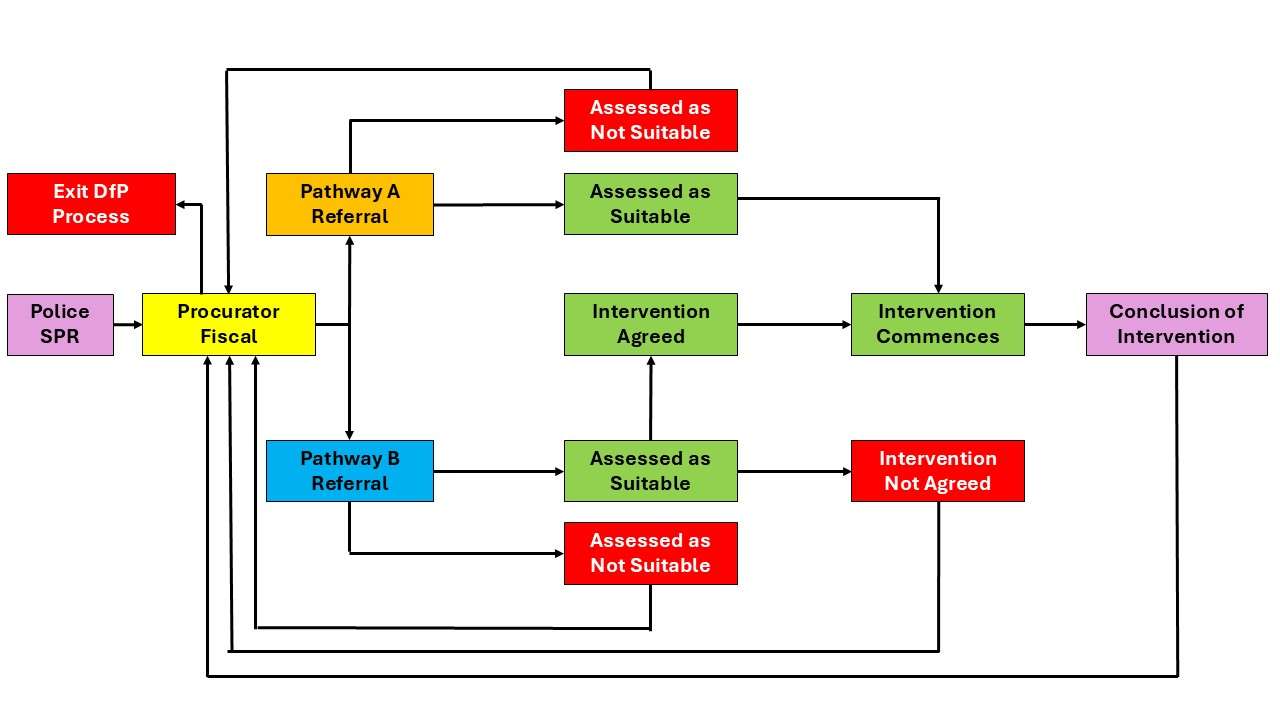
The Procurator Fiscal will also decide what level of communication is required with the Local Authority. In most cases, the Procurator Fiscal will be content that the Local Authority can commence work as soon as a person is assessed as suitable and accepts DfP. These cases would follow communication Pathway A.
In other, for example more serious, complex, or sensitive cases, the Procurator Fiscal will require to have confirmation of suitability and information about the proposed diversion intervention before making a decision to formally offer diversion. These cases will follow communication Pathway B. Pathway B cases will also follow the deferred model.
Pathway B cases are predicated on the agreement of both the Procurator Fiscal and the Local Authority on the nature and duration of any proposed DfP intervention prior to commencement in order that the case is managed effectively and safely in the community.
There is no definitive list of types of case or offence which should be considered as a Pathway B case, but any allegations of domestic abuse, stalking or sexual offending should proceed as a Pathway B case.
In general the decision of whether a case is Pathway A or B will lie with the Procurator Fiscal, However, if, the Local Authority are of the view that the case should be dealt with differently, they should raise with this the Procurator Fiscal and explain why. In some cases this might result in the case being redefined as a Pathway B or, in some circumstances alternative measures taken by the Procurator Fiscal.
Communication
When writing to the person, the Procurator Fiscal will:
- Confirm that participation in DfP is voluntary and highlight that if the person has any queries about such, then legal advice may be sought.
- Outline the possible outcomes of engagement or non-engagement with the DfP process.
- Outline the fact that reporting of further criminal behaviour or any interference with witnesses may result in the offer of DfP being withdrawn.
- Clearly advise how the person can reject the offer of assessment for suitability for DfP[11].
- Stipulate that the content of any discussion which forms part of the DfP assessment for the particular offence for which DfP was offered, will not generally be referred to in any future prosecution.
When making a referral to a Local Authority, the Procurator Fiscal will complete the appropriate referral form and:
- Share the summary of evidence, information about the person’s background, criminal history, the relevant charges for which diversion is being offered, and any other information that is likely to assist social work to carry out an assessment [12]. SPRs will never be shared with the Local Authorities.
- Confirm whether the decision on prosecution has been waived (if there is, then there is no need for further correspondence from the Local Authority).
- Confirm what communication Pathway should be taken. If Pathway A – then the case can proceed without further communication with the Procurator Fiscal. If Pathway B a further discussion will be required before work can start.
- Provide contact details in case further discussion is required.
It is the responsibility of the Procurator Fiscal to communicate with any victim of crime. In some cases, this communication will take place proactively, in other cases, information will be provided on request.
Referrals are made to the Local Authority, but delivery of DfP may be outsourced to partners in the 3rd Sector[13]DfP will, generally, be coordinated by Justice Social Work teams.
There is no requirement for specific interventions to be available for specific types of offence. DfP should be tailored to the needs of the person and should be available across the country. Those delivering interventions should make use of all local services available to them, e.g. 3rd sector partners, etc. Local services can be found using the Community Interventions and Support Directory (CISD) maintained by CJS on their website.
DfP is not limited to certain offence types / category or alleged person. All people should be assessed for DfP when a request to do so has been made by the Procurator Fiscal.
Both paraprofessional and social work qualified staff may be required to deliver DfP cases and will be allocated to appropriately qualified and trained workers, with cases being allocated based on their complexity and the knowledge, skills, and training of the identified worker. In particular staff delivering diversion interventions involving allegations of domestic abuse and/or harmful sexual behaviour must be appropriately trained and supported to do so.
Timescales
In Pathway A, the Local Authority will have 25 working days from date of receipt to undertake a Suitability Report (SR) and, where appropriate, commence identified intervention(s). There is no requirement to send the Suitability Report to the Procurator Fiscal in Pathway A cases – notification details are outlined in Appendix 1.
If the Suitability Report indicates DfP is not viable this should be notified to the Procurator Fiscal at the end of the period of assessment by return email on conclusion of the assessment with the SR included in these circumstances.
Where the Local Authority requires clarification prior to commencement , dialogue between them and the referring Procurator Fiscal should take place – for example if the need(s) identified by the Procurator Fiscal in the referral were at odds with any information that emerged during the Local Authority assessment (but the case is still deemed overall suitable for DfP).
In Pathway B cases, following the Local Authority assessment of the case (within 25 working days from date of receipt), the Procurator Fiscal and the Local Authority must agree on the proposed Intervention Plan and timescales prior to the commencement of any intervention.
Where the Procurator Fiscal and the Local Authority cannot reach an agreement on the Intervention Plan and/or timescales, then the DfP intervention cannot be progressed. Where this is the situation, the Procurator Fiscal will determine the progress of the case in line with COPFS policy.
Assessment Process
In addition to the information provided by the Procurator Fiscal, the assessor should access as a wide a range of information as is necessary and proportionate, including but not limited to information from (if relevant):
- Social work colleagues in other teams or services
- Health and Social Care colleagues
- Alcohol and drugs services
- Any other third sector agency where the person may already be receiving support, including advocacy services
Local Authorities should undertake a holistic suitability assessment which takes into account:
- The person’s understanding of the referral from the Procurator Fiscal and the fact that DfP is voluntary
- The person’s circumstances, and views of the alleged offence (DfP does not require a statement of ‘guilt’ or ‘innocence’ by the person, however, the person must accept that an incident took place and that they will engage in support or an intervention to address the underlying issues/needs)
- The person’s willingness to be involved in the DfP process
- The intervention or activities that will be delivered or expected during DfP
- The person’s expectation of the process and outcome of DfP
Issues relating to the protection of others should be given paramount consideration. It would not be appropriate for a Local Authority to decide that particular categories of offences are unsuitable for DfP, but any concerns about the risk of harm to the public or a specific person must be communicated to the Procurator Fiscal. Before taking on any DfP case the Local Authority must ensure it can effectively and safely manage the case towards a positive outcome.
Suitability Report
The Suitability Report should use the template form (Appendix 2) and as a minimum, must include:
- Dates of contacts offered and attended by the person OR where the person did not engage, details of all contacts offered
- Rationale of suitability or non-suitability for the identified DfP Pathway
- Identified and agreed need(s) on which DfP is predicated
- Intervention Plan with indicative timescales
In Pathway A cases, where the person is assessed as suitable, the Procurator Fiscal does not require a copy of the Suitability Report – this would only be required in the case of unsuitability. In Pathway B cases it would always be required irrespective of the assessment outcome.
Effect of different Pathways
Where Pathway A has been identified in the referral from the Procurator Fiscal then on completion of the Suitability Report the intervention should commence immediately – the Local Authority does not need to wait for agreement from the Procurator Fiscal. Though the Local Authority should confirm the individual is suitable and work has commenced.
Where Pathway B has been identified, there will be a requirement for further communication between the Local Authority and the Procurator Fiscal to agree the intervention(s) identified by the Local Authority . Only after the Suitability Assessment has been reviewed by the Procurator Fiscal and authorisation to progress provided, will the Local Authority commence delivery of the Intervention and Outcome Plan.
In Pathway B cases, the Procurator Fiscal will acknowledge receipt of the Suitability Report and confirm a decision within 15 working days. Where it will take longer to obtain a decision, the Procurator Fiscal will advise the Local Authority of this.
DfP Suitability Report Options
| Outcome | Circumstances (examples) | Pathway A | Pathway B |
|---|---|---|---|
| NOT SUITABLE | Person did not attend for assessmentPerson does not want to participate in DfPLocal Authority information or assessment indicates Person is unsuitable for DfP | The Suitability Report is compiled by the Local Authority and returned to the referring Procurator Fiscal within 25 working days stating reasons for unsuitability | The Suitability Report is compiled by the Local Authority and returned to the referring Procurator Fiscal within 25 working days stating reasons for unsuitability – with particular focus on why the Local Authority is of the view that it cannot manage the case effectively and safely in the community |
| SUITABLE | The Suitability Report notes: Intervention PlanTimescale of DfP In some cases, the focus of DfP will be to support the person’s ongoing engagement with another agency / any sustained progress since the date of offence. | The Suitability Report is retained by the Local Authority and intervention can commence immediately. | The Suitability Report is submitted to the Procurator Fiscal within 25 working days. The Procurator Fiscal reviews the Report and: Agrees with the Intervention Plan OR Does not agree with the Intervention Plan OR Requests further information The Local Authority will not commence intervention until authorisation has been received from the Procurator Fiscal. A reply from the Procurator Fiscal should be provided within 15 working days. |
Prosecutors rely on the expertise of Local Authority and considerable weight will be given to their professional judgement. It is vital therefore that the Local Authority or partner agency provide the explanation and rationale for their views, particularly where the person is assessed as unsuitable.
Intervention Content
Engagement with the person should be proactive and assertive.
The following should be considered by DfP assessors and those who deliver interventions:
- DfP may include activities such as advice, support, offence-focussed work, mediation, restorative approaches, and referral to other agencies.
- While restorative justice practices are encouraged in DfP interventions, Restorative Justice (as a process) should not be considered an integral part of any DfP work undertaken.
- There should be a focus on the impact of alleged offending behaviour on any victims of crime.
- It may be that some cases will require minimal intervention based on the person and/or the circumstances of the alleged offending behaviour and support people have accessed or are currently accessing.
- Given the wide range of alleged offending behaviour referred for DfP, interventions should be tailored to meet person’s needs and circumstances in a holistic and creative manner.
- The proposed programme of work should be agreed with the person but afford sufficient flexibility to respond to other issues as they arise.
- Interventions should both address any need(s) identified by the referring Procurator Fiscal (if valid) and those the Local Authority identifies during the assessment. In identifying these needs there must be collaboration with the person. The intervention may be delivered exclusively by one agency or by adopting a mixed service provision.
- Particular consideration should be given to the age, stage, and characteristics of the person in order that the mode and manner of the intervention is one which best suits them.
- Throughout the delivery of DfP, levels of contact should be reviewed in light of the progress and/or how people respond to the intervention on offer to them.
- Where issues of child, adult and/or public protection become known, workers involved in the DfP process should escalate this as appropriate and in line with policy and practice in their area, and if there are concerns about the accused’s risk to the public or a person, this should be relayed to the Procurator Fiscal.
Timescales
DfP will generally be completed within a three-month period, however, more complex Pathway B cases may take longer but still represent a focused, time-limited targeted intervention – for example, Pathway B cases may be expected to take up to 9 months. It would not be appropriate for diversion to be continued on an indefinite basis. Extensions to timescales can be agreed between the Local Authority and the Procurator Fiscal based if required – where this is the case, it must be recorded appropriately by both agencies.
It may be appropriate to limit the DfP period due to particular factors being addressed, or the satisfactory progress made by the person. When this is the case, the Local Authority should write to the Procurator Fiscal to inform them of such, and that their recommendation to conclude the DfP at that juncture.
The Plan for Intervention
The plan for DfP intervention should be formulated utilising information from both the identified need(s) from the Procurator Fiscal and also the needs identified in the suitability assessment process. It should detail projected timescales and the planned intervention in each case. In particular, the plan should highlight the frequency and rationale for levels of contact based on the circumstances of each case. The plan is incorporated as part of the Suitability Report template (see Appendix 2).
In Pathway A cases, there is no requirement to send the plan to the referring Procurator Fiscal.
However, in Pathway B cases, it must always be sent as part of the process of agreeing proposed intervention.
Early Termination of DfP
Where any agency involved in the DfP process becomes aware of further offending behaviour, or other conduct, for example unwanted contact with a victim of crime, which may suggest DfP is not appropriate, this should be urgently raised with the Procurator Fiscal who will consider if the offer of DfP remains in the public interest.
Where further offending behaviour impacts on the decision to offer DfP, the Procurator Fiscal will alert the Local Authority within 2 working days of such a decision being made.
Intervention Report and Conclusion
A report by the Local Authority must be submitted to the Procurator Fiscal on the completion / termination of the DfP intervention. The Intervention Report template form (Appendix 3) should be used for this. The report should be concise and highlight the following aspects of the DfP process. The report should be concise and highlight the following aspects of the DfP process.
- How need(s) identified by the Procurator Fiscal at the point of referral and the LA during assessment were addressed, including the nature of the intervention.
- The impact of the DfP process on the person citing any evidence of change as is appropriate.
- Where relevant, particular focus should be on insight into the effect of any harm and/or impact of alleged offending behaviour(s) and any evidence to support this.
- Where there has been non-compliance the evidence for this must be fully recorded, including the rationale for early termination of the DfP intervention .
- Any other factors which may be of relevance to the Procurator Fiscal in terms of proceeding to a conclusion in the case.
- Identify issues that have not been resolved entirely, with advice offered to the person as to how to achieve this.
DfP Intervention Report Outcomes
| Outcome | Circumstances (examples) | Pathway A | Pathway B |
|---|---|---|---|
| Intervention not completed | Person did not attend at all.Person’s attendance was intermittent and inconsistent.Person did not engage with the activities or achieve the outcomes identified in the initial Assessment Report. | The Intervention Report is submitted to the Procurator Fiscal within five working days (of service termination) detailing reasons for non-compliance. | The Intervention Report is submitted to the Procurator Fiscal within five working days (of service termination) detailing reasons for non-compliance. |
| Intervention completed | All intervention activities were achieved to an agreed standard and successful outcome(s) achieved. | The Intervention Report is submitted to the Procurator Fiscal within ten working days (of last appointment) detailing progress and outcomes. | The Intervention Report is submitted to the Procurator Fiscal within ten working days (of last appointment) detailing progress and outcomes. |
(iv) Procurator Fiscal
On receipt of the Intervention Report the Procurator Fiscal will review the information in order to determine the final outcome of the case. The Procurator Fiscal will advise the person and if appropriate, the victim(s) of crime or witness, on the final outcome in the case.
It is the responsibility of the Procurator Fiscal to communicate with any victim of crime. In some cases, this communication will take place proactively, in other cases, information will be provided on request.
Diversion from Prosecution Process Map
References
[1] Joint review of diversion from prosecution (www.gov.scot)
[5] About Us – National Trauma Transformation Programme
[6] Section 48(5) of the Scotland Act 1998 (legislation.gov.uk)
[7] An identifiable need may include (but will not be limited to) dependence on substances, mental health needs, welfare, and social inclusion needs. Link to case studies.
[11] There is no requirement for an accused to admit their guilt, but the offer of diversion must be accepted, and it is open to the accused to reject.
[12] The processing of any information will be undertaken with reference to the Data Protection Act 2018 (DPA18 Data Protection Act 2018 (legislation.gov.uk)) and the United Kingdom General Data Protection Regulation (UK GDPR Guide to the UK General Data Protection Regulation (UK GDPR) | ICO), in particular, DPA18 Part 3 which permits processing of information for a law enforcement purpose, Section 8(a) of the DPA18 and Article 6(1)e of UK GDPR.
[13] There are many 3rd sector partners across Local Authority areas – resources can be found at: Community Interventions and Support Directory – Community Justice Scotland//
Appendices
Appendix 1
Pathway A Intervention Commencement Notification to Procurator Fiscal (by email)
| Pathway A Commencement Notification | |||
| Person Referred: | DoB: | ||
| PR Ref Number: | SW Ref Number: | ||
| Date of Intervention Commencement: | |||
| Indicative period of Intervention: | 3 months | ||
Appendix 2
DIVERSION FROM PROSECUTION: PATHWAY A – SUITABILITY REPORT (SR)
| Diversion from Prosecution – Suitability Report | |
| COPFS Reference | |
| SW Reference | |
| Local Authority | |
| Referring Procurator Fiscal | |
| Name | |
| Telephone Number | |
| Person’s Details | |
| Name | |
| Date of Birth | |
| Address | |
Information from Procurator Fiscal:
| Summary of alleged offence |
| Details of identified need(s) |
| Victim Consideration(s) |
| Nature of DfP Case | |
| Date of Referral | |
| Receiving Local Authority | |
To be completed by Local Authority:
| Report Author | |
| Name | |
| Telephone Number | |
| Position | |
| Date | |
| Signature | |
| Pathway A – there is no pre-sentence risk assessment tool currently associated with DfP. The Suitability Report should be focused on the welfare needs identified by the PF, through interview and the use of an appropriate needs assessment, for example outcome star or radar chart. Concerns about any safety issues around child, adult and/or public protection should be reported to the Procurator Fiscal. |
| DfP – assessed as suitable Tick here if suitable | ||
| Interview date(s) | ||
| Needs identified (state) | ||
| Intervention identified (state) | ||
| Indicative timescale (state) | ||
| DfP – assessed as unsuitable – tick one option below and provide detail | |
| Person refused – state evidence (contact made but they did not engage with the DfP process or has explicitly stated they do not wish to participate) | |
| Unable to make contact – state evidence (social work has been unable to make contact with them despite the following attempts) | |
| Agency assessment indicates unsuitability – state evidence (the person cannot be appropriately dealt with by Local Authority) | |
| Other – detail evidence | |
DIVERSION FROM PROSECUTION: PATHWAY B – SUITABILITY REPORT
| Diversion from Prosecution – Suitability Report | |
| COPFS Reference | |
| SW Reference | |
| Local Authority | |
| Referring Procurator Fiscal | |
| Name | |
| Telephone Number | |
| Person’s Details | |
| Name | |
| Date of Birth | |
| Address | |
| Nature of DfP Case | |
| Date of Referral | |
| Receiving Local Authority | |
| Report Author | |
| Name | |
| Position | |
| Telephone Number | |
| Position | |
| Date | |
| Signature | |
| Pathway B – due to the nature of the alleged offence Justice Services do not have an appropriate pre-sentence risk assessment tool to identify the potential risks and intervention/treatment needs that may be required to safely manage the potential risks in the community. This Suitability Report is focused on the welfare needs identified by the PF, through interview and the use of an appropriate needs assessment, for example outcome star or radar chart. DfP does not deliver risk-based interventions. |
| If Suitable Tick here if Suitable | |
| Interview/verification | |
| (interview details, documents referenced, verification, liaison etc.) | |
| Assessment | |
| (needs, risks, rationale etc.) | |
| Intervention Plan | |
| (activities, referrals, intervention, outcomes etc.) | |
| Indicative Timescale | |
| If NOT SUITABLE | |
| Tick one of the boxes below and give details as indicated | |
| Person refused – contact made but they did not engage with the DfP process or has explicitly stated they do not wish to participate: (please provide details below) | |
| Unable to make contact – social work has been unable to make contact with them despite the following attempts: (please provide details below) | |
| Agency assessment indicates unsuitability – the person cannot be appropriately dealt with by Local Authority. This is on the basis that: (please provide details below) | |
| Other – For the reasons outlined, the person is not suitable for DfP: (full details to be provided) | |
Appendix 3
DIVERSION FROM PROSECUTION: PATHWAY A – INTERVENTION REPORT (IR)
| Diversion from Prosecution – Intervention Report | |
| COPFS Reference | |
| SW Reference | |
| Local Authority | |
| Referring Procurator Fiscal | |
| Name | |
| Telephone Number | |
| Person’s Details | |
| Name | |
| Date of Birth | |
| Address | |
| Report Author | |
| Name | |
| Telephone Number | |
| Position | |
| Date | |
| Signature | |
| Key Dates | |
| PF Referral | |
| Intervention commenced | |
| Intervention ceased | |
| DfP – intervention delivered | |
| Engagement/participation (state) | |
| Needs addressed (state) | |
| Outcomes identified (state) | |
| Length of DfP (state) | |
| Outcome of DfP | |||
| Completed | Not completed | ||
| Where DfP not completed, provide details: |
| (non-attendance, non-engagement etc.) |
DIVERSION FROM PROSECUTION: PATHWAY B – INTERVENTION REPORT (IR)
| Diversion from Prosecution – Intervention Report | |
| COPFS Reference | |
| SW Reference | |
| Local Authority | |
| Referring Procurator Fiscal | |
| Name | |
| Telephone Number | |
| Person’s Details | |
| Name | |
| Date of Birth | |
| Address | |
| Report Author | |
| Name | |
| Telephone Number | |
| Position | |
| Date | |
| Signature | |
| Key Dates | |
| PF Referral | |
| Intervention commenced | |
| Intervention ceased | |
| Report Details |
| (summary of initial assessment, needs etc.) |
| Engagement and Participation |
| (attendance, session regularity etc.) |
| Intervention Plan Progress |
| (nature of the intervention – focused work, providers, outcomes etc) |
| Any other relevant information not captured above: |
| Outcome of DfP | |||
| Completed | Not completed | ||
| Where DfP not completed, provide details: |
| (non-attendance, non-engagement etc.) |
Appendix 4
FEEDBACK TEMPLATE (for LA use only)
| PF Reference: | |
| SW Reference |
| Social Work Contact | |
| Name | |
| Telephone Number | |
| Prosecutor Contact | |
| Name | |
| Telephone Number | |
| Person’s Details | |
| Name | |
| Date of Birth | |
| Address | |
| Nature of DfP Case | |
| Pathway A* | |
| Pathway B* | |
| DfP Feedback (tick as appropriate) | |||||
| 1. Did you understand why you were on DfP? | |||||
| YES | NO | PARTIALLY | |||
| In your own words, can you explain your understanding: | |||||
| 2. Were you been treated with courtesy and respect by justice social work staff? | |||||
| YES | NO | PARTIALLY | |||
| In your own words, can you explain your understanding: | |||||
| 3. Were you provided with clear information/instruction throughout the DfP process | |||||
| YES | NO | PARTIALLY | |||
| In your own words, can you explain your understanding: | |||||
| 4. What worked well for you on DfP? | |||||
| 5. What could have been better? | |||||
| 6. Do you have any other comments or suggestions? | |||||
Date of Feedback: