Commissioning – Voluntary Throughcare – Lessons Learned
Community Justice Scotland (CJS) established the Commissioning Project in May 2022 in response to the Scottish Government’s new Community Justice Strategy, which expressed an ambition to enhance the use of voluntary throughcare services.
This included a dedicated research and evidence-gathering phase (September 2022 to April 2023), an options appraising phase (Summer to September 2023), a grant process (Spring and Summer 2024) followed by a transition and stand-up of the new service (November 2024 to April 2025).
On 1 April 2025 a new voluntary throughcare service (‘Upside’) was officially launched, marking the conclusion of the Commissioning Project.
The CJS commissioning project team are grateful to everyone who took the time to complete surveys, participate in discussions and share their feedback. The openness and insight provided by contributors have been invaluable in identifying key lessons, informing findings and shaping future improvements. Thank you for your engagement, commitment and support throughout this process.
This external report is based on the full internal lessons learned review. It condenses detailed operational material, protects anonymity and presents the learning in a proportionate form for publication. It should be read as an account of the commissioning process and its improvement lessons, not as a full evaluation of service outcomes.
Read the report below.

Background
Between 2012 and April 2025, dedicated throughcare support for individuals released from custody was provided by local authority Justice Social Work services, voluntary sector Public Social Partnerships (PSPs) funded by the Scottish Government (SG), and other voluntary sector support services. The voluntary throughcare service, funded by the Scottish Government (SG), was delivered through the PSP model by three key services: Shine (for women), New Routes (for men), and, until April 2024, Moving On (for young people under 21).
In 2022, the SG published the new Community Justice Strategy, which expressed an ambition to enhance the use of voluntary throughcare services, stated in priority action 10 of the strategy:
Enhance community integration and support by increasing and promoting greater use of voluntary throughcare and third sector services.
With this renewed ambition and in the absence of any formal review or recommissioning of the PSP services for voluntary throughcare since 2012, upon request from the SG, Community Justice Scotland (CJS) undertook a review of the current provision of commissioned voluntary sector throughcare and mentoring services. The purpose of this project (the ‘commissioning project’) was to generate potential options for the future improved delivery of commissioned throughcare services.
The commissioning project was established in May 2022, with the following aims:
- Review the effectiveness of existing service delivery.
- Build a robust evidence base for best practices in voluntary throughcare.
- Develop an options appraisal for the future of voluntary throughcare service delivery funded by this grant, to be considered by the Cabinet Secretary for Justice and Home Affairs (referred to as the Cabinet Secretary for the purposes of this paper). Depending on the outcome of the options appraisal, this could result in a funding call for third sector organisations to apply and the establishment of a new service.
The commissioning project included a dedicated research and evidence-gathering (September 2022 to April 2023) phase, an options appraising phase (Summer to September 2023), a grant process (Spring and Summer 2024) followed by a transition and stand up phase of the new service (November 2024 to April 2025).
On 1 April 2025 a new voluntary throughcare service (‘Upside’) was officially launched, marking the conclusion of the commissioning project.
Purpose
The lessons learned approach in project management is invaluable for anticipating factors that could impact future projects. Research by Cranfield University School of Management highlights that the key differentiator between successful and unsuccessful organisations is their willingness to publish and share lessons learned (Association of Project Management 2025). CJS recognises the importance of learning from past projects to make improvements to future projects, and to recognise and retain successes.
Throughout the commissioning project CJS, sought feedback from stakeholders, albeit on an ad hoc basis. On project conclusion, CJS gathered further insights from key stakeholders to identify project successes and areas for improvement. The lessons learned here will be used to ensure that any future commissioning projects consider and learn from the successes and identified improvement opportunities of this project.
Acknowledgements
The CJS commissioning project team are grateful to everyone who took the time to complete surveys, participate in discussions and share their feedback. The openness and insight provided by contributors have been invaluable in identifying key lessons, informing findings and shaping future improvements. Thank you for your engagement, commitment and support throughout this process.
Commissioning Project: Overview and Stakeholders
The commissioning project was delivered in several phases with several key stakeholders[1] involved in each. Lessons learned activities sought to gather views and information from each of these stakeholders, both generally and also the specific project phase(s).
[1] 1 Scottish Government throughcare and reintegration team, Scottish Prison Service, Social Work Scotland, Criminal Justice Voluntary Sector Forum, individual third sector service providers, Local Authority justice social work leads, Community Justice Partnership (CJPs) Chairs and coordinators, NHS Health Board Contacts, members of the commissioning governance groups (project steering committee and project management committee), grant assessment panel members and grant applicants, external consultants including project management, grant support and research.
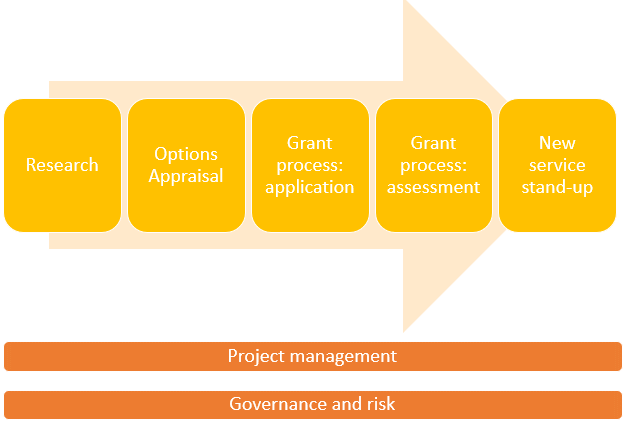
Figure 1. Phases of the project from research through to new service stand-up, with overarching themes of project management and governance and risk.
Lessons Learned: Method
To gather as much information as possible, lessons learned activities were conducted using:
- Surveys: written feedback was sought from external stakeholders via survey. This allowed rich qualitative information to be gathered from these key stakeholders about key aspects of the commissioning project.
- Workshops/meetings: discussions with CJS colleagues to gather information and views. This allowed detailed discussion of specific points to be captured.
Where appropriate, spontaneous feedback received from stakeholders was also included.
Survey design
Four surveys (Grant process: application, Grant process: assessment, New service stand-up, Project management) were disseminated to key stakeholders. In the interests of ensuring that information covered a broad spectrum of opinion, most of the questions were open with free text response fields. Questions asked can be found at Appendix 1, at the bottom of this publication, after Closing Statement. Respondents were given three weeks to complete the survey, with a reminder email sent after two weeks.
Survey response rates were similar across the four surveys, with the exception of the ‘grant process: application’ survey which achieved a lower rate:
- Grant process: application: 10% (18 responses)
- Grant process: assessment: 25% (4 responses)
- New service stand up: 28% (5 responses)
- Project management: 34% (12 responses)
Workshop design
Workshops were held with CJS colleagues and were focussed on the key stages of the project. Each workshop followed a similar format, with the facilitator asking open-ending questions based on a range of key activities and themes for each project stage.
A separate meeting held with CJS’ Chief Executive and Director of Operations to capture their views on the totality of the project.
Methodological Limitations
- The exercise was designed for organisational learning rather than formal independent evaluation.
- Some activity occurred a considerable time before feedback was gathered, which may have affected recall and participation.
- Response rates ranged from 10% to 34%, and some respondent groups were very small.
- People who contributed to the earlier research were not re-contacted for this lessons learned exercise because of elapsed time and practical limitations.
- Qualitative findings reflect experience and perception. They have been retained where views differed and should not be read as quantified consensus.
Key Findings
The voluntary throughcare commissioning project successfully achieved its core purpose: to commission an expanded national service that improves access to voluntary throughcare for people leaving custody after a short-term prison sentence of less than four years and, for the first time, extends eligibility to males leaving custody following a period on remand. The project also secured a significant uplift in investment, with voluntary throughcare funding increasing from approximately £3.8m per annum to £5.3m, alongside a move to multi-year funding of three years with the potential to extend for a further two years. It also opened up this grant fund to new organisations formally for the first time since 2012.
The new service, Upside, launched nationally on 1 April 2025, delivered by a partnership of third sector organisations led by Sacro, and early evidence indicates that it is being positively received by Community Justice Partnerships, NHS colleagues, other professional stakeholders and people accessing support.
This was the first commissioning and grant management project of this scale undertaken by CJS on behalf of the SG. It translated national strategy into an expanded service, secured increased and multi-year investment, widened eligibility and established a new national partnership.
The project delivered a substantial legacy for CJS producing a suite of research and evidence on voluntary throughcare, options appraisal capacity, grant documentation and assessment tools, embedded the involvement of people with lived experience within research and grant assessment activity, and established new grant management and outcome reporting arrangements.
Successes
An evidence-informed approach was maintained from the research phase through to commissioning and service design, helping to ensure that decisions were informed by identified needs, service evidence and stakeholder perspectives. Lived experience was also meaningfully incorporated into the project, including within decision-making and assessment processes, contributing valuable insight alongside professional expertise.
During the grant phase, applicants benefited from responsive support from CJS, positive engagement with SG and partners, and the effective involvement of a the grant-making body The Corra Foundation. The process helped facilitate partnership development across the third sector, supported by a Register of Interest that encouraged collaboration and networking opportunities. Feedback highlighted positive experiences of the guidance and collaborative approach adopted throughout the application process. Assessment arrangements were strengthened through the inclusion of both professional and lived experience perspectives, with panels described as diverse and well facilitated.
The service mobilisation phase was characterised by strong collaboration between CJS, Sacro and delivery partners, alongside responsive communication throughout implementation. Once funding was confirmed, funding drawdown arrangements operated effectively, supporting mobilisation activity. The programme successfully progressed from commissioning to the launch of a new national service with an effective transition into service delivery, albeit within challenging timescales for the Upside partners.
Strong partnership working was a consistent feature throughout the project, supported by collaboration across organisations, sectors and disciplines.
Cross-Phase Reflections
Feedback indicated opportunities to strengthen planning, project management and governance arrangements in future projects of a similar scale. It was noted that many of the timescales were out with the control of CJS.
Stakeholder engagement was mostly positive apart from some mixed views on inclusivity during the grant application phase and mixed views on the value of collaborative meetings in the new-service stand-up phase.
Communication was not viewed as positive or negative consistently throughout the project phases. There were examples of good internal and external communication during the latter phases of the project. A recurring theme across several phases was that changes to decision-making timescales affected subsequent communication with stakeholders and influenced stakeholder relationships.
Robust ethical oversight and good use of the risk register from the governance groups and well facilitated and managed panels in the assessment phase were highly praised and valued, although it has been reflected that a single project governance group of sufficient responsibility and authority could be considered for future projects to improve efficiency and reduce duplication.
Key Lessons Learned
Early and realistic planning – incorporating the political and budgetary calendar – is essential and projects should be adequately resourced with staffing planned according to the project phases. Early identification of any skills gaps allows external expertise to be budgeted for and procured if necessary. Regular supervision, senior oversight and appropriate pacing of work protects staff wellbeing.
A governance group should be established at the earliest opportunity and could involve people with lived experience and equal decision-making authority to add value. Trauma-informed practices and ethical oversight are essential when working with vulnerable people and should continue to be adopted for future projects.
Clear communication and stakeholder engagement is essential and should be inclusive and transparent. A robust communication plan should be developed with a view to providing proactive, consistent updates and have flexibility to be reactive should unforeseen circumstances arise.
When running a grant application process, all application guidance, criteria and documentation should be published simultaneously to support fair understanding and competition.
Assessment frameworks must be clear and strictly applied. Guidance should include good examples explaining scoring protocols, that must be consistently applied by each assessor during the assessment phase.
Funding structures should support inclusion, not foster more competition amongst organisations. Funding in arrears especially at the levels seen in this project (£1.325m per quarter) can preclude the involvement of smaller organisations. Multi-year funding agreements enable better planning and staff retention, and upfront commitments improve inclusivity for smaller, grassroots organisation.
The new service stand-up phase benefited from strong collaboration between CJS, Sacro and partners, responsive communication, and a manageable funding drawdown process once funding was agreed. However, future service mobilisation needed earlier funding certainty, clearer communications, realistic timescales of at least six months for complex national services, and better-paced progress meetings to protect delivery quality, staff wellbeing and partnership relationships.
This is particularly pertinent to SG as funders and commissioner, with some reflections for CJS’ commissioning, planning and advocacy role.
For CJS as grant manager and commissioning support, the lessons are less about funding decisions and more about assurance, coordination, communication and constructive support during mobilisation, while avoiding duplication of the provider’s operational responsibilities.
Feedback should be gathered at the end of each project phase whilst participants are still engaged and memory of participation is fresh, rather than at project conclusion, to minimise the loss of involvement and or insights from participants.
Lessons learned should inform future projects and be embedded into organisational project management approaches.
Closing Statement
The voluntary throughcare commissioning project has offered valuable insights and significant learning opportunities for CJS to shape future commissioning opportunities and strengthen organisational capability.
The learning is significant. Contributors described strong collaboration, responsive support, credible evidence and inclusive assessment. They also identified avoidable ambiguity, pressures created by delayed decisions and compressed timescales, barriers for smaller organisations and the need for better planned communication and mobilisation.
CJS accepts that both parts of this story matter. Celebrating delivery does not require overlooking the pressure involved, and acknowledging improvement opportunities does not diminish the achievement. The strongest response is to retain what worked, act on what did not and continue to involve partners and people with lived experience in shaping future practice.
Appendix 1: Survey Questions
For each survey, the following questions were asked:
- What was your role in the commissioning project? [options listed with checkboxes]
- Overall, how would you rate your satisfaction with the ‘xxx’ stage? [very satisfied / satisfied / neutral / dissatisfied / very dissatisfied]
- What worked well during the ‘xxx’ stage? [free text]
- What do you think could have been improved during the ‘xxx’ stage? [free text]
- Was communication, engagement and the relationship with CJS project team sufficient during this process? Are there any improvements that could have been made? [free text]
- Is there anything else you would like to tell us about the ‘xxx’ stage? [free text]
A final question informed respondents that information they submitted would remain anonymous unless they were happy to leave contact details for the purposes of potential follow-up discussion. A space for free text response to include contact details was available.
About this publication
This external report is based on the full internal lessons learned review. It condenses detailed operational material, protects anonymity and presents the learning in a proportionate form for publication. It should be read as an account of the commissioning process and its improvement lessons, not as a full evaluation of service outcomes.