Community Justice Outcome Activity Annual Report 2024-25
We are pleased to present the Community Justice Scotland (CJS) Outcome Activity Annual Report 2024/25.
This report sets out an assessment of community justice activity that took place across Scotland between 1 April 2024 and 31 March 2025 in pursuit of the shared community justice outcomes.
Looking ahead, CJS will support national and local improvement activity informed by the evidence set out here. This includes continued workshops and seminars on themes, regular deep-dive bulletins, research and reporting, improved data sharing, partnership engagement, and support for local and national improvement projects.
CJS will continue to advocate for sustained investment in community justice and greater national awareness of its impact

Community justice is a cornerstone of public safety, fairness and social justice in Scotland. When it functions well, it prevents harm before it takes root, reduces further offending, supports victims and helps people rebuild their lives in ways that strengthen families and communities alike. When it falters, the consequences reverberate across our courts, our prisons and our neighbourhoods.
This report sets out Scotland’s performance against the four national aims of the Community Justice Strategy during 2024/25. It does so differently to previous years. It takes a more open, more challenging account of progress. It speaks directly to Scotland’s people, those who work across the system, and to Scottish Ministers and decision makers about where ambition is being realised – and where it is falling short.
The evidence presented in the report shows progress is being made. Much of it is driven by sustained collaboration, innovation and determination at a local level. Across Scotland we see growing confidence in diversion and early intervention, stronger leadership and more integrated support across housing, health, employability and though care. This matters. It reduces unnecessary justice involvement, improves outcomes for those who experience the system and delivers better value for public investment. But the picture is uneven. Progress is neither equal, nor consistent, nor guaranteed. The national aim to ensure robust, high-quality community interventions available everywhere and trusted by the courts, has not yet been achieved. In practice, someone’s access to bail support, restorative justice, structured supervision or specialist interventions still depends too heavily on where they live, the capacity of local services and whether or not short-term funding or staffing pressures can be absorbed. These variations shape real-world outcomes – whether support is available at a critical moment, whether community alternatives are used with confidence, and whether opportunities to reduce further harm are taken or missed.
We need to acknowledge the context in which this work is taking place. Workforce shortages, rising complexity of need, unreliable data, emergency prison measures and a national housing crisis all form the background of this year’s findings. This scale of effort by Community Justice Partnerships is significant, but effort alone is not enough.
If community justice is to deliver on its aims, national ambition must be matched by national alignment, sustained investment and clearer accountability. Too often, expectations are placed on local partnerships without the consistent resources, reliable data, national support or infrastructure required to meet them at pace and at scale.
This report is intentionally transparent about what the evidence tells us, and what it cannot yet tell us. Where more data is needed, we say so. Where progress is slow, we explain why. And where promising practice is emerging, we highlight it as proof that better outcomes are possible and achievable when the system is properly supported.
Crucially, the report also reflects the voices and experiences of people who live with the impact of the justice system. Their insight reinforces a consistent message: access to timely, person centred, trauma informed support changes lives and prevents future harm.
Community justice will continue to play an increasingly vital role in Scotland’s justice landscape. That makes it all the more important that progress is honest, performance is understood in context, and improvement is actively supported rather than assumed.
Community Justice Scotland will continue to challenge where change is needed, advocate for what works, and support improvement nationally and locally. This report is not the final word — it is an invitation to act, to align behind shared ambition, and to ensure community justice is consistently available, properly valued and capable of delivering the safer Scotland we all want.

Introduction
The Community Justice Scotland (CJS) Outcome Activity Annual Report (OAAR) examines progress in community justice across Scotland during 2024/25, assessed against the aims and activities set out in the National Strategy for Community Justice.
The report draws on template responses submitted by Community Justice Partnerships (CJPs) and their partners. These returns describe progress, opportunities, and challenges in delivering community justice at local authority level, as required under the Community Justice (Scotland) Act 2016.
The activity described reflects partners shared responsibility to design and deliver services that promote rehabilitation and reintegration from a person’s first contact with the justice system through to their exit from it, with the aim of reducing further offending.
Community Justice (CJ) Statutory partners include local authorities (LAs); health boards; the Chief Constable of the Police Service of Scotland (PSoS); Scottish Fire and Rescue Service (SFRS); Skills Development Scotland; Integration Joint Boards established under section 9 of the Public Bodies (Joint Working) (Scotland) Act 2014; Scottish Courts and Tribunals Service (SCTS); and Scottish Ministers, through the Crown Office and Procurator Fiscal Service (COPFS) and the Scottish Prison Service (SPS).
This year’s report seeks not only to describe activity, but to challenge Ministers, decision-makers and the public to think more ambitiously about the role, value and impact of community justice. It makes the case for stronger emphasis, investment and policy weighting for services that are often life-changing for individuals, families and communities, and that rely on sustained delivery across the public and third-sectors.
The report includes a horizon scan intended to prompt discussion on how community justice can be sustained and strengthened within a challenging and evolving justice landscape.
Workshops were also used to develop the report’s ‘So What?’, focusing on what the evidence tells us and how it can be translated into tangible improvements for people who experience the justice system and those who work within it.
Looking ahead, CJS will support national and local improvement activity informed by the evidence set out here. This includes continued workshops and seminars on priority themes, regular deep-dive bulletins, research and reporting, improved data sharing, partnership engagement, and support for local and national improvement projects. CJS will continue to advocate for sustained investment in community justice and greater national awareness of its impact.
Overall Progress & Key Insights
The Scottish Government’s National Strategy for Community Justice sets out the national direction for community justice and highlights four overarching aims, 13 priority actions, and 9 nationally determined outcomes.
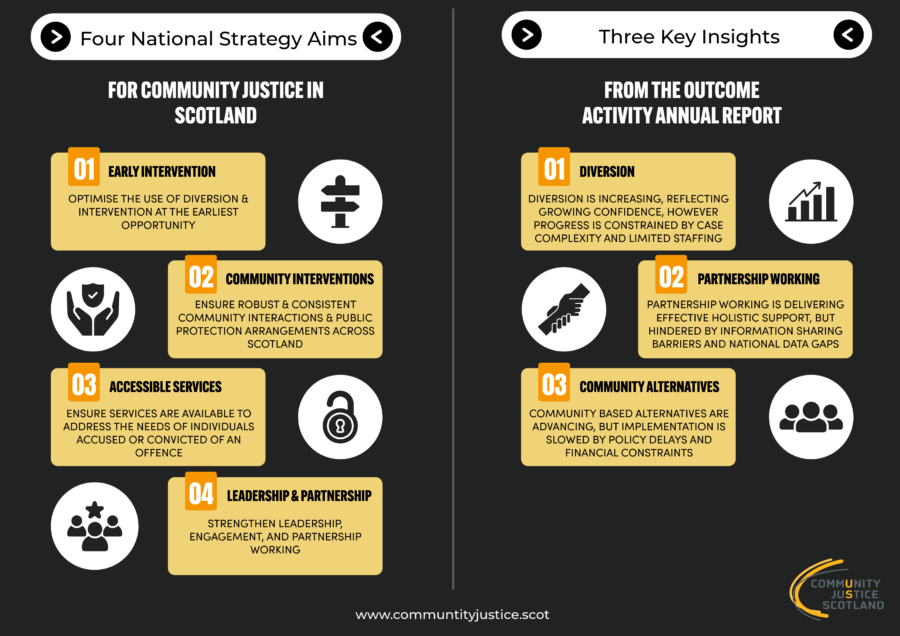
Community Justice Scotland has a legislative duty to report to Scottish Ministers its assessment of performance in Scotland as a whole in relation to the achievement of the national outcomes (as set out in S27 of the Community Justice (Scotland) Act 2016). To do so, we have used the national indicator data as set out in the community justice performance framework, coupled with local evidence collected throughout the reporting year and other publicly available information. To provide a fuller assessment of progress towards achieving the national strategy for community justice, we have looked at all priority actions even if they do not have corresponding outcomes and/or indicator data.
Table 1 – Progress of Nationally Determined Outcomes
| National Aims | Priority Actions | Nationally Determined Outcomes | Status of achievement | Progress Made | Key Challenges |
|---|---|---|---|---|---|
| National Aim 1: Optimise the use of Diversion and Intervention at the Earliest Opportunity | Enhance intervention at the earliest opportunity by ensuring greater consistency, confidence in and awareness of services which support the use of direct measures and diversion from prosecution. | More people successfully complete diversion from prosecution. | Progressing | Based on the national indicators, there has been progress made in regards to the increasing number of assessments undertaken, cases commenced, and cases successfully completed compared to 23/24. | There remains a high degree of local variation. |
| Improve the identification of underlying needs and the delivery of support following arrest by ensuring the provision of person-centered care within police custody and building upon referral opportunities to services including substance use and mental health services. | More people in custody receive support to address their needs. | No formal assessment possible | National and collaborative work to drive improvements in relation to arrest referral began and remains ongoing. | This indicator is relatively new, and changes to data collection methods between 2023/24 and 2024/25 mean that formal assessment of progress cannot be made at this stage. | |
| National Aim 2: Ensure that robust and high-quality community interventions and public protection arrangements are consistently available across Scotland | Support the use of robust alternatives to remand by ensuring high quality bail services are consistently available and delivered effectively. | More people are assessed for and successfully complete bail supervision. | Progressing | Based on the national indicators, there has been progress made in the number of assessments undertaken, cases commenced, and cases completed. | There remains a high degree of local variation. |
| Strengthen options for safe and supported management in the community by increasing and widening the use of electronic monitoring technologies. | No nationally determined outcome or indicator. | No formal assessment possible | There has been notable growth in the use of electronic monitoring as a bail condition. | Community Justice Scotland has highlighted challenges related to the achievement of this priority action. Significant progress is needed in relation to: The development and implementation of policy relating to new electronic monitoring technologies. Enhanced support for those subject to electronic monitoring. The development and introduction of a nationally determined outcome and indicator. | |
| Ensure that those given community sentences are supervised and supported appropriately to protect the public, promote desistance from offending and enable rehabilitation by delivering high quality, consistently available, trauma-informed services and programmes. | More people access services to support desistance and successfully complete community sentences. | Lack of progress | Based on national indicators, there has been a 2% increase in the number to Drug Treatment and Testing Orders (DTTOs) successfully completed in 2024/25 compared to the previous year. | Based on national indicators, there has been no change in the percentage of Community Payback Orders (CPOs) successfully completed in 2024/25 when compared to the previous year. The number of DTTOs imposed was at its lowest in the last decade, and a number of local areas have highlighted challenges to service delivery. | |
| Ensure restorative justice is available across Scotland to all those who wish to access it by promoting and supporting the appropriate and save provision of available services. | No nationally determined outcome or indicator. | Lack of progress | Most partnerships report little or no local progress on Restorative Justice (RJ), citing the absence of a sustainable funding model to support training and service delivery. | ||
| National Aim 3: Ensure that services are accessible and available to address the needs of individuals accused or convicted of an offence | Enhance individuals’ access to health and social care and continuity of care following release from prison by improving the sharing of information and partnership-working between relevant partners. | More people have access to, and continuity of, health and social care following release from a prison sentence. | Progressing | Based on the national indicator data, there was a 21% increase in the number of transfers from drug/alcohol treatments in custody to community in 2024/25 compared to the previous year. | |
| Ensure that the housing needs of individuals in prison are addressed consistently and at an early stage by fully implementing and embedding the Sustainable Housing on Release for Everyone (SHORE) standards across all local authority areas. | More people have access to sustainable accommodation following release from a prison sentence. | Lack of progress | In October 2024, the SHORE Quality Standards were revised to reflect legislative and policy changes, alongside an action plan setting out future strategic development. | At a national level there has been no change compared to the previous year. The housing national and local housing emergency continues to hinder progress in relation to this national outcome. | |
| Enhance individuals’ life skills and readiness for employment by ensuring increased access to employability support through effective education, learning, training, career services and relevant benefit services | More people with convictions access support to enhance their readiness for employment. | Lack of progress | Returns highlight strong development of employability and life-skills through integrated, person-centred approaches and close working between justice services, employability providers, and third-sector. | The percentage of people reporting a conviction has remained relatively consistent since the introduction of this indicator but does not yet demonstrate increased access. CJS recognise that despite close working and operational activity, the current indicator may not effectively capture this progress. | |
| National Aim 4: Strengthen the leadership, engagement, and partnership working of local and national community justice partners | Deliver improved community justice outcomes by ensuring that effective leadership and governance arrangements are in place and working well, collaborating with partners and planning strategically. | No nationally determined outcome or indicator. | No formal assessment possible | Community Justice Improvement Plans are embedded within wider strategic frameworks, including Local Outcome Improvement Plans and Community Planning arrangements. Governance structures have been reviewed or formalised, and many areas have completed self-evaluations using Care Inspectorate principles, with a focus on leadership and performance management. Collaboration has strengthened through cross-representation on strategic groups such as Alcohol and Drug Partnerships and Violence Against Women and Girls Partnerships, and through more integrated service models. | A lack of national outcome and indicator data make it difficult to prioritise and monitor improvements to this priority action. |
| Enhance partnership planning and implementation by ensuring the voices of victims of crime, survivors, those with lived experience and their families are effectively incorporated and embedded. | More people across the workforce and in the community understand, and have confidence in, community justice. | No formal assessment possible | Data from the most recent Scottish Crime and Justice Survey in 2023/24, indicates that 83% of people agree that “people should help their community as part of a community sentence rather than spend a few months in prison for a minor offence”. | Community Justice Scotland recognise the challenges associated with the development of a national indicator which adequately assesses improvements in relation to this national outcome. The current indicator cannot be broken down by local authority and the nature of sampling limits the utility of this data for assessing progress towards the outcome. | |
| Support integration and reduce stigma by ensuring the community and workforce have an improved understanding of and confidence in community justice. | No nationally determined outcome or indicator. | No formal assessment possible | Skills and confidence across services have been strengthened through widespread trauma-informed practice training. | The lack of a national outcome and indicator data make it difficult to prioritise and monitor improvements to this priority action. |
Progress Towards Recommendations
The 2023/24 report made four recommendations focusing on key themes: resourcing for community justice, enhanced data sharing and analysis, workforce capacity and skills, and system development in electronic monitoring.
Table 2 – Progress towards recommendations
| Recommendation | Focus Area | Progress Made | Key Challenges |
|---|---|---|---|
| Resourcing for Community Justice | Align funds with policy ambitions | – Strengthened local governance – Integrated plans unlocking shared funding – Targeted third-sector investment – Improved accountability | – Funding remains below policy ambition – Workforce pressures – Delays to Diversion from Prosecution guidance availability |
| Data Sharing and Analysis | Improve access to local and national data and information | – Locally developed dashboards – Streamlined reporting – Enhanced assessment tools – Better collaboration | – Inconsistent access to national data – Gaps in local knowledge – Blockages in information flows – Delays in sharing case information |
| Workforce Capacity and Skills | Training needs and delivery | – High uptake of trauma-informed training – Multiagency training sessions – Increase in national programs | – Operational Pressures – Reliance on short-term funding – Delays in national direction |
| Electronic Monitoring (EM) | Maximise EM opportunities | – Increased uptake in some areas – Multiagency training – Engagement with tech providers | – Inconsistent judicial uptake – Geographical and infrastructure challenges – Low conversion rates between EM recommendation and case commencement |
Horizon Scan
| Time | Event | Description |
|---|---|---|
| 2025 – 2027 | Prison Population Crisis | Careful planning over the next 3 years will be vital to strengthen community justice capacity and ensure a smooth and supportive transition from custody to community. |
| December 2025 | Sentencing Commission | The Independent Sentencing and Penal Policy Commission is expected to conclude and publish recommendations that could reshape community justice. |
| May 2026 | Holyrood Election | The election marks a key moment for engagement and building relationships that will help shape future justice priorities. |
| July 2026 – October 2026 | Public Sector Reform | Gathering pace after the 2026 election and presenting a pivotal opportunity to position community justice as central to efficiency, prevention, and public sector collaboration. |
| January 2027 – May 2027 | Strategic Redesign | Subject to the outcome of the strategy review and Ministerial views, a revised National Strategy for community justice and a refreshed Vision for Justice may be planned offering a chance to set clear priorities and shape the future direction of Scotland’s justice system. |
S26 National Overview
S26 National Overview with Baselines
| National Indicators | Current Year | Previous Year | Pre-Covid Year (2019-20) | Baseline Year | Desired Indicator Direction | Current Indicator Direction | National Progress | CJS Statement |
| Number of diversion assessments undertaken | 5,925 | 5,551 | 2,752 | 2,526 | Increase | Increased | Progressing | The number of diversion assessments undertaken shows an increase compared to both the baseline year and the previous year. The increase is in line with the desired direction. |
| Number of diversion cases commenced | 3,594 | 3,351 | 1,990 | 1,725 | Increase | Increased | Progressing | The number of diversion commencements shows an increase compared to both the baseline year and the previous year. The increase is in line with the desired direction. |
| Number of diversion cases successfully completed | 3,085 | 2,412 | 1,578 | 1,367 | Increase | Increased | Progressing | The number of diversion completions shows an increase compared to both the baseline year and the previous year. The increase is in line with the desired direction. |
| Percentage of community payback orders successfully completed | 71% | 71% | 69% | 69% | Increase | No Change | No Change | The percentage of CPO completions shows an increase compared to the baseline year, however there is no change compared to the previous year. The desired direction is to increase. |
| Percentage of drug treatment and testing orders successfully completed | 53% | 50% | 39% | 39% | Increase | Increased | Progressing | The percentage of DTTO completions shows an increase compared to both the baseline year and the previous year. The increase is in line with the desired direction. |
| Number of homelessness application where prison was the property the main applicant became homeless from | 1,740 | 1,660 | 2,005 | 1,870 | Decrease | Increased | No Change | The number of homelessness applications where prison was the property the main applicant became homeless from, shows a decrease compared to the baseline year, however there is an increase compared to the previous year, the desired direction is to decrease. |
| Number of voluntary throughcare cases commenced | 1,409 | 1,727 | 2,022 | 2,084 | Increase | Decreased | Not Progressing | The number of voluntary throughcare cases commenced shows a decrease compared to both the baseline year and the previous year. The desired direction is to increase. |
S26 National Overview without Baselines
| National Indicator | Current Year | Previous Year | Desired Indicator Direction | Current Indicator Direction | National Progress | CJS Statement |
| Number of referrals from custody centres | 976 | Increase | The number of referrals from custody centres has a single data point available for this period, it is not possible to assess trends or comment on direction at this stage. | |||
| Number of assessment reports for bail suitability | 5,781 | 5,887 | Increase | Decreased | Not Progressing | The number of assessments undertaken shows a decrease where the desired direction is to increase. |
| Number of bail supervision cases commenced | 1,525 | 1,302 | Increase | Increased | Progressing | The number of commencements shows an increase in line with the desired direction. |
| Number of bail supervision cases completed | 1,109 | 853 | Increase | Increased | Progressing | The number of bail completions shows an increase in line with the desired direction. |
| Number of transfers in drug/alcohol treatments from custody to community | 1,179 | 971 | Increase | Increased | Progressing | The number of transfers in drug/alcohol treatments from custody to community shows and increase in line with the desired direction. |
| Percentage of those in employability services with convictions | 7% | 6% | Increase | Increased | Progressing | The percentage of people referred to NOLB employment programmes with a criminal record shows an increase in line with the desired direction. |
| Percentage of people who agree that people should help their community as part of a community sentence rather than spend a few months in prison for a minor offence | 83% | 82% | Increase | Increased | Progressing | The percentage of people who agree that people should help their community as part of a community sentence rather than spend a few months in prison for a minor offence shows an increase in line with the desired direction. |
National Performance
National Challenges
| Top 3 National Challenges | National Picture from OAAR Returns | Local Evidence from OAAR Returns |
| Recruitment and Workforce Capacity | 17 out of 30 local authority areas (57%) reported difficulties in recruiting and retaining staff, particularly in Justice Social Work and specialist roles (e.g., addiction nurses, unpaid supervisors). | Aberdeen City: Struggles with recruiting task supervisors and throughcare staff.Clackmannanshire: Workforce resilience issues due to increased demand and static budgets.Highlands: Recruitment challenges in remote areas affecting service consistency. |
| Housing and Homelessness Pressures | Reintegration is hindered by limited housing stock, long waits for temporary accommodation and increased homelessness presentations: National Evidence: Homelessness remains high; households spend ~238–305 days in temporary accommodation.National Evidence: The total new housing supply felt by 16.4% in 2023-24 (a drop of 3,984 homes). | Stirling: 18% rise in homelessness presentations; average 331 days in temporary accommodation.Aberdeenshire: Early releases strained housing availability, reducing time for support planning.West Dunbartonshire: National housing emergency impacted SHORE commitments. National Evidence: An increase from ~2.9% to ~9.1% of people arriving at custody with no fixed adobe. |
| Funding Constraints and Sustainability | Short-term funding cycles and insufficient core funding limit innovation and continuity of services: National Evidence: Criminal Justice Committee budget-submission notes 77% of Justice Social Worker managers reported a shortfall in funding, specially for the Caledonian system.National Evidence: £148m allocated to community justice, including an additional £14m to expand community‑based interventions.National Evidence: In 2022-23, CJ accounted for only 1.53% of the total Justice & Veterans budget with a drop of 1.47% in 2023-24. | Falkirk: Caledonian programme facing major funding cuts. Moray: Lack of ring-fenced funding restricts improvement activities. North Lanarkshire: Funding doesn’t cover coordinator costs or support lived experience engagement. |
National Opportunities
| Top 3 National Opportunities | National Picture from OAAR Returns | Local Evidence from OAAR Returns |
| 1. Enhanced Partnership Working and Co-Location | Stronger collaboration between statutory and third sector partners, often through co-located services, is improving outcomes. | Perth and Kinross: Co-located services enabled rapid response to legislative changes. East Renfrewshire: Justice employability officer co-located with employability services.West Lothian: Civic Centre co-location supports integrated working. |
| 2. Trauma-Informed and Person-Centred Approaches | Many local authority areas are embedding trauma-informed practice and tailoring support to individual needs: National Evidence:12,500 Police Scotland officers completed mandatory naloxone training as part of the national roll-out.National Evidence: 85% of ROJS participants accessed health and employability opportunities.National Evidence: National framework requires all police officers to be trained to Trauma-skilled level. | Clackmannanshire: Naloxone policy and trauma-informed training.South Lanarkshire: Recovery oriented Justice Service Integrated health and justice.West Dunbartonshire: All staff trained to trauma-skilled level. |
| 3. Innovative use of Diversion and Structured Sentence | Increased use of diversion from prosecution and structured deferred sentences is supporting rehabilitation and reducing custody reliance: National Evidence: Structured Deferred Sentences finished has increased from 1,305 to 1,389 from 2023-24 to 2024-25.National Picture: Diversion Cases Successfully Completed has increased from 2,412 to 3,085 from 2023-24 to 2024-25. National Picture: 83% of people agree that people should help their community as part | Aberdeen City: High completion rates for diversion and structured deferred sentences.Dundee City: Rise in Structured Deferred Sentences and Diversion Completions.Stirling: Growing confidence in Structured Deferred Sentences as an alternative to traditional sentencing. |
National Aim 1
Local Performance & Indicator Analysis
National Indicator – Number of diversions from prosecution (assessments undertaken, cases commenced, and cases successfully completed):
Based on the national indicator data, progress has been made in regards to the number of diversion assessments undertaken (+7%), cases commenced (+7%), and cases successfully completed (+28%), compared to 23/24.
Locally, data on diversion activity shows marked variation across Scotland, indicating uneven implementation and potential gaps in local service delivery.
Locally, the number of assessments range from two to 1055. Assessments per 10,000 of the population indicate wide variation.
- Highest rates: Glasgow City, Highland, and East Ayrshire (17 – 23 per 10,000)
- Lowest rates: Shetland and Edinburgh (3 – 5 per 10,000)
The number of cases commenced range from six to 516. Cases commenced per 10,000 population differ noticeably across areas:
- Highest rates: East Ayrshire, Dumfries & Galloway, Argyll and Bute, and Aberdeen (14 – 15 per 10,000)
- Lowest rates: East Renfrewshire, Inverclyde, and Shetland (3 per 10,000)
The number of cases successfully completed ranges from zero to 430. There is also variations in the rate of cases successfully completed per 10,000 of the population: - Highest rates: East Ayrshire, Dumfries & Galloway, and Aberdeen City (10 – 11 per 10,000)
- Lowest rates: East Renfrewshire, Inverclyde, and Orkney (0 – 2 per 10,000)
This measure alone does not indicate success or failure. Low rates may reflect lower crime rates, effective upstream prevention, or restrictive eligibility criteria. Higher rates may indicate proactive diversion or higher local need. Without wider justice system context, including the volume of eligible cases or local offence profiles, interpretation remains limited.
Approximate commencement rates, based on the number of assessments which progress to cases commencing was ~63% nationally. Seven areas report conversion rates of 50% or less from assessment to case commencement, suggesting potential issues with capacity, eligibility criteria, awareness and/or engagement.
National Indicator – Number of arrest referrals from custody centres:
Arrest referral data does not include referrals made by healthcare staff, or those directly made between support service link workers and those in custody. Additionally, this indicator is relatively new and changes to how data was collected between 2023-24 and 2024-25 make it difficult to compare over time.
While it is not possible to present local performance data or specific variation, it is important to highlight the factors that are likely to influence it. There are a range of underlying factors that can drive variation between locations, and referral rates might differ widely as a result. These differences may reflect local processes, operational pressures, staffing approaches, or recording practices. Understanding what sits behind any variation is critical, as surface-level comparisons alone rarely provide an accurate picture of performance or need.
Areas where referral rates appear high may suggest strong processes for identifying need at the point of custody, supported by effective relationships between custody staff and community-based services. However, high referral activity may also be influenced by higher volumes of people coming through custody, which can increase referrals without necessarily indicating an improvement in how need is identified.
Areas where referral rates appear low may point to limited staff capacity, confidence, or training in recognising individuals who may benefit from support. It could also reflect inconsistencies or gaps in triage and recording processes. Lower custodial throughput might mean fewer opportunities to generate referrals. Alternatively, lower rates may indicate that upstream prevention or early intervention is working effectively and reducing the need for referral.
Differences between areas that have comparable levels of need or deprivation would suggest that local practice, staffing models, operational culture, and data-recording quality might have a greater influence on referral activity than deprivation alone.
It is important to recognise that this indicator reflects activity rather than impact. Higher referral rates do not, in themselves, demonstrate improved outcomes, and lower rates may reflect effective prevention or targeted intervention rather than poor performance
National Progress
- In August 2024 the Lord Advocate issued revised guidance on Police Direct Measures. The guidance widened eligibility and extended the range of offences covered, increasing officer discretion. Early indications from local areas suggest an increase in the use of Police Recorded Warnings, reducing the number of police reports submitted and subsequent justice system contact. Police Scotland continues to work with local and national partners to strengthen referral opportunities at the point of a direct measure, ensuring early support is offered where needs are identified.
- Justice Social Work, the Crown Office and Procurator Fiscal Service, Police Scotland, CJS and the Scottish Government progressed work on revising the national Diversion from Prosecution Guidance. Publication is expected in 2026, alongside awareness-raising activity and a supporting training product.
- In 2025, an Arrest Referral Conference held at Edinburgh Napier University laid the foundations for the Strategic Open Doors Network, led by Police Scotland under the Community Justice National Delivery Plan. National work is underway to address barriers to third-sector and lived-experience involvement in custody settings, improve information sharing systems and introduce ‘arrest referral champions’ to foster a culture of support and engagement.
Local Progress
- Person-centred and collaborative approaches underpin effective diversion. Examples include the provision of flexible engagement at home, in the community and digitally across Aberdeen City and the Clackmannanshire STRIVE partnership which provides bespoke early interventions for those with complex needs who may not meet the threshold for other services.
- The increased use of exit questionnaires is supporting service improvement nationally. Aberdeen City’s Justice Feedback Improvement Project, established in early 2024, aims to collect feedback from 80% of people completing diversion by 2026. Increased use of exit questionnaires is also reported in East Dunbartonshire, Ayrshire and Aberdeenshire.
- Feedback highlights improvements in individuals’ ability to manage setbacks, make decisions in their own lives, and understand the impact of their behaviour on victims and communities. Several areas report effective feedback loops that use a clear ‘You Said, We Did’ approach to service improvement. In Renfrewshire, a new improvement framework sets out how feedback from people diverted from prosecution will be routinely gathered. Arrest referral activity is increasing in most areas and is typically delivered through partnership working between Police Scotland, CJPs, Alcohol and Drug Partnerships and third-sector organisations. Local areas emphasise that effective schemes require consistent referral pathways, opportunities to build rapport, appropriate access to custody suites, proportionate information sharing and the ability to operate across local authority boundaries. Alongside custody interventions, court support operates in several areas, including Fife and East Lothian. This includes weekly Sheriff Court drop-in sessions and ‘navigator’ approaches that provide immediate support to individuals attending court.
- The range of referral pathways required to support people in custody reflects the complexity of need. Demand is highest for mental health and drug and alcohol services, alongside access to GPs, food, electricity support, emotional support and naloxone distribution. Notable arrest referral schemes include West Lothian ‘Change, Grow, Live’ project, North Lanarkshire Pheonix Futures and Recovery Scotland collaboration and the Highland Custody Link Worker Project.
Notable Challenges
- Local areas report that progress on diversion from prosecution is not consistently matched by funding or staffing capacity. In Ayrshire, waiting lists have developed and no additional partnership funding is available. Aberdeenshire has lost a dedicated diversion social worker post due to unsustainable caseloads, resulting in diversion work being spread across wider teams. There is increasing demand for tailored interventions, specialist skills and greater use of qualified social workers rather than ‘paraprofessional’ roles. This reflects rising complexity among individuals considered for diversion, including young people and an increase in domestic and sexual abuse cases. In response to this Fife are creating a range of bespoke programmes to meet demand, including The Heathy Relationships Programme which can be completed during the lifespan of a diversion intervention.
- Delays between the offence and referral for diversion affect engagement. Limited case information further hampers early and effective intervention. In some cases, individuals’ circumstances have changed by the time a referral is received, requiring cases to be returned for alternative options.
- High levels of need can also result in limited engagement despite sustained effort from staff. In Perth and Kinross, some individuals decline diversion due to unclear communication between the Crown Office and Procurator Fiscal Service and Justice Social Work contacts.
- Inconsistencies exist in the availability of arrest referral across Scotland. This is exacerbated in part by variation in access to custody suites for some third-sector organisations, inconsistent data provision, and a focus on drug and alcohol issues over other additional needs (albeit, these may be picked up additionally by provider organisations).
National Aim 2
Ensure that robust and high-quality Community Interventions & Public Protection arrangements are consistently available across Scotland
Local Performance & Indicator Analysis
National Indicator – Number of assessment reports for suitability, bail supervision cases commenced, and bail supervision cases completed:
Based on the national indicator data, the number of bail assessments undertaken rose sharply between 2022-23 and 2023-24 (+29.7%), before a slight dip in the period 2024-25 (-1.4%). There has also been progress made in relation to the number of cases commenced (+17%), and cases successfully completed (+30%) compared to 23/24.
Largest assessment volumes: Glasgow City (841), Fife (499), City of Edinburgh (425), North Ayrshire (388), Highland (358).
The national commencement rate was 26% in 2024-25, which is about a 2% increase on the previous year. Local performance in bail supervision varies considerably across Scotland. Some areas report conversion rates of up to 100%, meaning that once an assessment is completed, a large proportion of cases move into active supervision. This may indicate well-aligned local processes or effective alignment between assessment outcomes and judicial decisions. In contrast, some areas show conversion rates as low as 6%, where only a small number of assessed individuals go on to begin supervision. In terms of improvement, Dundee City and East Lothian both saw a 74% improvement in regards to their commencement rates.
Nationally, the percentage of individuals deemed as not suitable for bail was 22%. However, Aberdeenshire, Orkney, Inverness, and Highland all had figures above 50% which is significantly higher than the Scottish average. A number of factors may influence suitability including crime types, individual risk, and need profiles as well as factors such as stable housing.
Areas working with very small case volumes require careful interpretation, as just a few cases can make percentages appear unusually high or low and may not represent the wider picture. Overall, local performance cannot be understood from percentages alone. Conversion rates, caseload size, local decision making, geography, and service capacity, all influence how bail supervision operates in different areas. Recognising these differences is essential for interpreting data fairly and identifying where further support or improvements may be required.
National Indicator – Percentage of community payback orders successfully completed:
Based on the national indicator data, the percentage of CPOs successfully completed remains stable and high (~71%). Over the past decade successful completion of CPOs has remained relatively consistent and between 70 – 72%. Locally, successful completion rates range between 59% and 79% suggesting varying local operational conditions.
Highest completion rates were recorded in Aberdeen City, Aberdeenshire, East Lothian, East Renfrewshire, and Moray (~74% – ~78.5%)
Lowest completion rates were found in Glasgow City, West Dunbartonshire, Clackmannanshire, and Falkirk (~60% – ~64%)
Completion rates for CPOs varied across Scotland in 2024-25. 10 authorities recorded decreases, while others, such as Edinburgh, Perth and Kinross, Orkney and Shetland, saw their completion rates improve. East Renfrewshire’s rate stayed the same. These trends are not always clear-cut, as increases in completion rates may be offset by rising breach rates, and outcomes are shaped not only by caseload volumes but also the distinct operational pressures present in each area.
National Indicator – Percentage of drug treatment and testing orders successfully completed:
The number of DTTOs imposed have fallen 62% since the 2018-19 peak with only 226 DTTOs being imposed in 2024-25. In terms of the national indicator, completion rates have risen by ~2% since 2023-24.
Locally, completion rates range from 0% to ~86%. Interpreting DTTO performance requires care due to the small numbers involved. Wide variation (0% – 86%) could indicate inconsistent service models and engagement outcomes. High breach and revocation rates in major urban authorities with larger caseloads show higher churn and instability which may be due to case complexity, individual suitability, and/or service delivery challenges.
National progress
- Legislative change through the Bail and Release from Custody (Scotland) Act 2023 aims to reduce use of remand by strengthening the presumption in favour of bail. Implemented in increments, final bail provisions came into force in May 2025.
- Between September and November 2024, all 32 local authorities completed a structured self-evaluation focused on how justice social work services gather, report, and respond to performance, quality and outcome data for community-based sentences. Validation exercises followed in Aberdeenshire, East Dunbartonshire, Fife, and Perth & Kinross. The report, published by the Care Inspectorate in May 2025, found strong commitment to improvement, but identified significant weaknesses in the systematic use of data. Locally, restrictive information systems and resource constraints were the main barriers. Nationally, the absence of agreed measures, tools, processes and priorities for data collection, alongside limitations in information-sharing infrastructure, continues to impede progress.
- CJS submitted the Restorative Justice Policy and Practice Framework to Scottish Government in March 2025. CJS and the Children and Young Peoples Centre for Justice (CYCJ) have been working with statutory and non-statutory partners to run test cases and explore delivery challenges and opportunities to inform a future, nationally consistent provision.
Local progress
- Person-centred and collaborative support remains central to effective delivery. Local returns consistently highlight partnership working between JSW, housing, health, mental health services and the third-sector as critical to addressing complex needs, supporting compliance and reducing reliance on remand.
- Local returns emphasise the importance of trauma-informed and trauma-responsive approaches. In some areas, including Aberdeenshire, Falkirk, Dumfries and Galloway, North Lanarkshire, Renfrewshire and West Dunbartonshire, this is reflected in enhanced and more integrated support for people with complex and intersecting needs related to housing, addiction and mental health. These approaches are associated with improved engagement, compliance and outcomes.
- The Care Inspectorate self-evaluation and validation project identified challenges in how performance and quality data are collected and used to support continuous improvement. These issues were echoed in local returns, which highlight ongoing difficulties in ensuring consistency in how data is collected and shared across partnerships. However, some areas report progress, including improved data gathering in Clackmannanshire, Dumfries and Galloway and North Lanarkshire, and the introduction of data dashboards in Ayrshire, and Perth and Kinross to support assessment of quality, performance and outcomes.
- Local returns highlight the need to strengthen judicial awareness and confidence in community options, particularly in relation to bail supervision and electronic monitoring. Areas report a range of initiatives, including information packs for sentencers in Moray, bail briefings and joint review sessions in Aberdeen City, increased use of court liaison meetings in South Lanarkshire and greater justice social work presence in courts in Glasgow. In Edinburgh City, the introduction of a dedicated court team is associated with an increase in bail supervision cases commencing.
Notable challenges
- Resourcing and capacity pressures continue to affect most areas. Limited justice social work presence in courts, driven by staffing and logistical constraints, has contributed to lower levels of bail assessment and supervision, particularly in multi-court and remote or rural areas such as Argyll and Bute. This restricts access to information and can undermine the quality and robustness of bail assessments and the likelihood of cases commencing.
- Despite year-on-year increases in bail assessments and cases commencing, conversion rates remain low in many areas. The national conversion rate is 23.5%, and some areas report that the Bail and Release from Custody (Scotland) Act 2023 has increased the likelihood of standard bail being granted following assessment, reducing conversion to supervision. Combined with capacity pressures, this limits the ability of some areas to prioritise improvement activity.
- Resource pressures also affect wider programme and service delivery, particularly given rising demand and increasing complexity among those supervised or supported in the community.
- Use of electronic monitoring remains variable, reflecting resourcing constraints, delays in access to improved technologies such as GPS, accommodation barriers, data gaps, variation in judicial confidence and logistical challenges, especially in remote and rural areas.
- Most partnerships report little or no local progress on Restorative Justice, citing the absence of a sustainable funding model to support training and service delivery as the main barrier.
National Aim 3
Ensure that services are accessible and available to address the needs of individuals accused or convicted of an offence
Local Performance & Indicator Analysis
National Indicator – Number of transfers in drug/alcohol treatments from custody to community:
The number of people moving from prison into community drug or alcohol treatment showed a mixed picture. 11 areas saw decreases in 2024–25, while others increased. Some areas experienced sharp rises or falls over just one year, often based on small numbers that can fluctuate easily. These changes might reflect shifts in local processes, staffing, service capacity, or the number of people leaving custody with treatment needs. Because the totals are small, transfers alone do not show whether access to treatment is improving or worsening. To understand performance meaningfully, additional information is needed, such as how many people were eligible, whether support was arranged before release, and whether people stayed engaged with support services after their release.
National Indicator – Number of homelessness applications where prison was the property the main applicant became homeless from:
The national aim is for fewer people to become homeless immediately after leaving prison. The most recent year shows mixed trends, including long-term reductions and short-term increase. 16 areas saw increases, 10 decreased, and 6 stayed the same. Differences between areas can reflect many factors such as where people choose to settle after custody, the availability of housing, relationships between local services, or changes in how homelessness is recorded. These shifts cannot be fully understood from application numbers alone and require consideration of release patterns, pre‑release housing planning, local supply of accommodation, and how well people sustain housing once they receive it.
National Indicator – Number of those in employability services with convictions:
The percentage of people with convictions using employability services fell in around half of local areas, but the changes were small and hard to interpret without knowing the actual number of people involved. Percentages alone can be misleading, as they may reflect changes in who else is using the service rather than changes in support for people with convictions. Understanding local performance requires complete datasets, along with information on outcomes such as how many people who experience justice move into training or work, complete programmes, or face barriers like housing or health issues.
National Indicator – Number of voluntary throughcare cases commenced:
The commencement of cases has decreased in 18 areas. Falling numbers may reflect fewer referrals or fewer short prison sentences, but might also indicate issues around engagement, barriers at the point of contact, or operational pressures. Conversion rates between referral and commencement vary greatly. Understanding why people do or do not engage requires better information about referral patterns, eligibility, and what happens after someone is offered support.
National Progress
- In response to prison overcrowding, emergency early release took place in June and July 2024 under the Early Release of Prisoners and Prescribed Victim Supporters (Scotland) Regulations 2024, using powers from the Bail and Release from Custody (Scotland) Act 2023.
- This was followed by the Prisoners (Early Release) (Scotland) Act 2025, which reduced the proportion of sentence served by some short-term prisoners from 50% to 40%, enabling phased releases in February and March 2025 and establishing provisions for future emergency releases.
- In 2024, the Scottish Parliament and 13 local councils declared a national housing emergency in response to rising homelessness, high use of temporary accommodation and shortages of affordable housing.
- Additionally, in October 2024, the Sustainable Housing on Release for Everyone (SHORE) Quality Standards were revised to reflect legislative and policy changes, alongside an action plan setting out future strategic development.
Local Progress
- Health and wellbeing are vital for successful reintegration. Alcohol and Drug Partnerships (ADPs) work closely with Community Justice Partnerships to support continuity of care for people leaving custody.
- Several ADPs have embedded Naloxone provision, overdose awareness training, and pre- and post-release support, including gate pick-ups and planning. Work also focuses on implementing Medication Assisted Treatment (MAT) standards in custody and community settings and improving continuity of care through information-sharing agreements. Innovative approaches include Inverclyde’s residential rehabilitation pathway linked to the national Prison to Rehab scheme, and Aberdeenshire’s multi-agency (132 staff from 14 services) ‘Days of Action’, which engaged hard-to-reach individuals.
- Housing support, guided by SHORE standards, remains a key priority. Stable accommodation is essential for rehabilitation and prevents risks such as homelessness, exploitation, and substance misuse. Ayrshire has explored solutions through a Departure Lounge Pilot, which tested immediate engagement with services and provided valuable lessons for future models.
- Multi-agency collaboration has improved significantly, reducing duplication and service gaps while enabling more holistic support. This approach proved especially valuable during Emergency Release and is now embedded through liberation planning meetings. Examples include Glasgow’s resource hub at HMP Barlinnie, which hosts multiple agencies for integrated support, and the EMORSS model in Edinburgh and Midlothian, which ensures continuity of care from custody to community.
- Areas are implementing innovative housing solutions to support reintegration. South Lanarkshire reports strong SHORE engagement, sustaining tenancies and exceeding permanent housing targets. Highland uses technology, such as sensors and doorbells, to enhance safety and reduce reoffending, while Fife is testing direct rehousing from prison to permanent accommodation. Glasgow’s Pathfinder to Housing, Health and Benefits (PHHaB) model has reduced homelessness applications through partnership working and new referral pathways. Inverclyde raised awareness through a SHORE conference, and West Lothian provides weekly addiction support to people in temporary accommodation through a joint HSCP initiative.
- Employability services have expanded, with Local Employability Partnerships (LEPs) embedding justice considerations into their strategies. Tailored pathways are now routinely offered to people on Community Payback Orders, nearing liberation, and with historic convictions to progress into work.
- Several areas have strengthened early engagement through prison-based initiatives, including hospitality training through the Greene King Academy at HMP Grampian and employability fairs at HMP Glenochil and HMP Kilmarnock. Accredited qualifications such as CSCS cards, REHIS Food Hygiene and First Aid are increasingly available in custody.
- Specialist and trauma-informed employability support is provided by organisations including Apex Scotland, Access to Industry and Stirling Community Enterprise. This includes disclosure advice, confidence-building and resilience training, alongside targeted work with high-barrier groups such as MAPPA clients and people with sexual convictions. In Renfrewshire, partnership working with Apex supported 19 individuals to progress towards employment.
- Creative programmes support wellbeing and reintegration. West Lothian partners with the Wise Group’s online life-skills platform, while initiatives such as podcasts, peer mentoring and sport-based projects including Street Soccer Scotland promote confidence, mental health, and employability for those on community sentences.
- Local partnerships are working to reduce stigma and promote inclusive recruitment. Employers including Greene King, Toyota, Network Rail and Kier Construction are offering opportunities. LEP-funded projects in Perth and Kinross and Greene King’s Academy have expanded access to training across sectors such as civil engineering and mechanics. Midlothian supports progression through volunteering and employer PVG training,alongside sport-based initiatives that combine employability and wellbeing. Voluntary throughcare is increasingly embedded within local partnerships. Digital campaigns and partnership events, including in Moray, have increased awareness and uptake, although some areas reported uncertainty during the transition.
- Holistic approaches to reintegration are evident across several areas. Clackmannanshire coordinates voluntary throughcare with NHS Forth Valley to support GP registration, prescriptions, and harm reduction, improving continuity of care and reducing relapse risk. Highland partners with APEX, SMART Recovery, and Greenspace projects to provide disclosure advice, mental health support, and employability training, boosting recovery engagement. In Dumfries and Galloway, Shine mentoring supports women with trauma histories through structured sentences and reintegration activities, increasing confidence, abstinence, and volunteering.
Notable Challenges
- Housing and accommodation challenges persist due to limited emergency accommodation and delays in accessing housing support. These issues are compounded by critical data gaps, including insufficient information on housing need and a lack of robust impact evaluations, which hinder planning and response.
- Health and wellbeing gaps remain a concern, with individuals often facing delays in access to medication and mental health services following release. Access to both general and mental health care is often dependent on GP registration, creating additional barriers.
- Information sharing and coordination remain problematic, with data exchange between agencies often inconsistent, particularly for people on remand. Aligning multi-agency plans for individuals with complex needs or early release adds further complexity.
- Resource and capacity pressures continue to affect delivery, with limited staffing and funding for voluntary throughcare and specialist support.
- Engagement and accessibility challenges arise when people with complex needs or chaotic lifestyles disengage from support. Those on remand or subject to unplanned release face additional barriers to timely access to services.
- Severe housing shortages, including national and local emergencies, are undermining SHORE delivery increasing risks of homelessness, reoffending, and harm. While some areas have embedded SHORE standards, others struggle due to limited housing supply, resulting in inconsistent delivery.
- Effective housing planning depends on timely and consistent information sharing but gaps in communication delay interventions and increase homelessness risk. Housing providers are not always notified when people enter custody, and tracking outcomes such as tenancy sustainment or homelessness presentations remain difficult. Many initiatives (including multiagency working itself) lack formal evaluation, and there is no unified system to monitor SHORE implementation or measure tenancy sustainment across local authorities.
- High levels of need among people leaving prison, including mental health, addictions and MAPPA cases, require intensive support. Severe resource and funding constraints limit Housing First and wraparound services, while early releases and court backlogs create unpredictable housing demand. Rural and island areas face additional barriers, including limited housing stock and confidentiality concerns.
- Disclosing convictions, particularly sexual offences, remains a major barrier to employment, with employers and education providers often reluctant to engage. Stigma and misunderstanding further restrict opportunities, including access to volunteering.
- Short-term funding cycles and withdrawal of national funding streams disrupt service continuity.
- Voluntary Throughcare uptake remains low, with feedback suggesting that many people are prioritising housing and employability over throughcare as more important for reintegration when leaving custody. However, this leaves many individuals without stable support or access to essential services.
National Aim 4
Strengthen the Leadership, Engagement & Partnership working of local and national community justice partners
National Progress
- By the end of 2024/25, the public campaign ‘Life Changing Sentence’ had reached three million people using 300 high impact billboard and displays in Police Stations, GP Surgeries and Libraries.
- The Community Intervention and Support Directory (CISD) launched in June 2024, providing justice professionals with a national directory of community services. It has received over 18,000 views, with feedback from Sheriffs highlighting its value in supporting consistent decision-making across locations. More than 1000 views and 500 unique visitors accessed the relaunched Justice System Map hosted on the CJS website.
Local Progress
- Strong leadership continues to drive progress. Aberdeen City’s shared Chair and Vice Chair role between Adult Social Work and Police Scotland supports joint accountability, while Ayrshire’s Community Justice Ayrshire Partnership Data Hub enables more evidence-led strategic planning.
- In response to the 2023/24 OAAR report, strategic alignment to other local partnerships now features as a key theme, particularly with Alcohol and Drug Partnerships (ADPs), Public Health, and Violence Against Women Partnerships (VAWP). This supports shared outcomes, improves community engagement and enables co-funding of key posts.
- The involvement of third-sector organisations within Community Justice Partnerships reflects priority justice areas and consistently strengthens community links.
- When engaging people with lived experience of justice, local areas highlight the importance of including families and using creative methods such as photography, storytelling and peer mentors to help design more holistic support services. These approaches improve participation and help reach people who are often missed by traditional surveys.
- Clackmannanshire has established a Lived Experience Panel to embed the voice of people with justice experience in planning. The panel is led by the Resilience Learning Partnership, which provides support, development opportunities and financial remuneration. In Dumfries and Galloway, the POP group engaged 18 people with justice experience through activities including a community garden, football club and shared meals.
- Feedback loops between services and people on community sentences are helping to make support more meaningful and person-centred. In East Lothian, a ‘Service User Feedback Month’ gathered anonymous feedback from 25 people, with participants describing staff as friendly, approachable, encouraging and practical.
Notable Challenges
- Engagement with victim support organisations remains challenging for local areas but is essential for effective community support and safety.
- Through consultation, local areas have highlighted challenges with engaging the COPFS and SCTS locally, in terms of their attendance at meetings and in understanding their role and commitment to local priority delivery.
- Creative engagement methods are needed to reach people who may not respond to traditional consultation methods. This continues to be as an ongoing challenge for local areas.
- The rise of social media platforms identifying people with convictions and inciting public outcry or protest has disrupted operational delivery, potentially impacting community safety, public confidence and impacting already limited resources.
Next steps
| Themes | Next Steps |
| 1. Early Intervention and Prevention | Aberdeenshire: Prioritising diversion from prosecution and bail supervision; reviewing Unpaid Work Service to meet demand. Clackmannanshire: Developing early intervention through a multi-disciplinary hub and addiction recovery support at first justice contact. Stirling: Preparing for Bail and Release from Custody Act implementation, increasing bail supervision and throughcare responsibilities. |
| 2. Lived Experience and Community Engagement | Angus: Recruitment of a participation worker to embed lived experience and human rights approach. Clackmannanshire: Expanding its Lived Experience Panel to influence annual report and partnership decisions. Renfrewshire: Committed to integrating client voice into planning and evaluation for justice services. |
| 3. Employability and Reintegration | East Renfrewshire: Co-location of justice employability officer withing justice and employability services.Scottish Borders: Launching and Employment Development Officer role to support people with convictions into sustainable jobs.Moray: Year 3 actions focus on employability as a key reintegration strategy. |
| 4. Trauma-Informed and Person-Centred Practice | Shetland: Rolling out trauma-informed practice sessions and working toward a trauma-informed workforce. Stirling: Expanding gender-responsive programmes like Women’s Group and non-court mandated domestic abuse programme. East Renfrewshire: Increasing trauma-informed training across justice and whole system. |
| 5. Restorative Justice and Victim Engagement | Highland: Planning a Restorative Justice event and designing local Restorative Justice models; improving victim engagement and information. Argyll and Bute: Highlighted Restorative Justice delivery as a priority but flagged funding as a barrier. Moray: Developing a victim’s information postcard co-designed with victims. |
| 6. Data, Self-Evaluation and Continuous Improvement | Angus: Establishing a SECI delivery group for self-evaluation of diversion services .East Dunbartonshire: Continuing self-evaluation and developing a local performance framework. Edinburgh: Conducted partnership self-evaluation and reviewing governance and funding allocation processes. |
| 7. Legislative and Policy Alignment | Stirling: Preparing for Bail and Release Act and SHORE standards review. Inverclyde: Exploring partnership release planning under Bail and Release Act. Argyll and Bute: Assessing impacts of multiple legislative changes (Children’s Care and Justice Act, Victims and Witnesses Bill). |
| 8. Resource and Capacity Challenges | East Dunbartonshire and East Renfrewshire: Significant budget cuts, staffing shortages and uncertainty around programme funding (e.g., Caledonian, Restorative Justice). Clackmannanshire: Concern over major reduction in Caledonian funding for 2026/27. Aberdeenshire: Recruitment and retention issues, lack of premises for service delivery. |
| 9. Collaboration and Co-Location | Dumfries and Galloway: Piloting joint mental health and justice support for CPO completion. East Renfrewshire: Co-location of justice and employability services. Falkirk: Exploring re-establishment of multi-agency arrest referral oversight group and improving custody health pathways. |