
Restorative Justice and Human Rights: a Facilitator’s Perspective
Gael Cochrane, Learning Development and Innovation Lead at Community Justice Scotland, explores the intersection of restorative justice principles and human rights values from her perspective as RJ practitioner.
NOTE: The views expressed are of the author and do not necessarily represent the views of Community Justice Scotland and other organisations that may be mentioned.
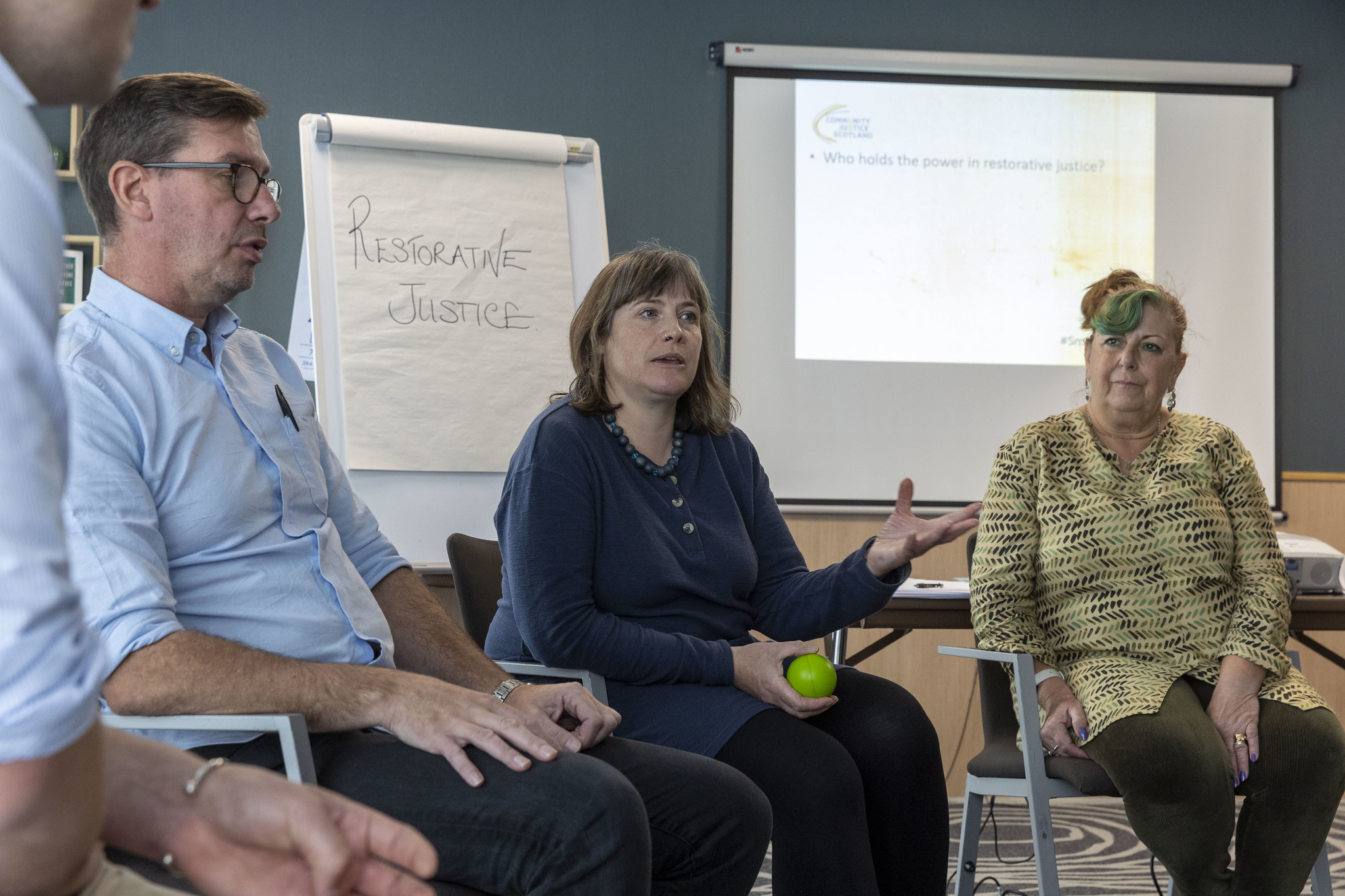
As a restorative justice practitioner, I’ve been asked to consider whether restorative justice (RJ) should be viewed as a human right. This question raises more questions than answers for me. Let’s start by asking: what are human rights?”
“Human rights refer to the basic rights and freedoms to which all humans are entitled” (United Nations, 1948), or as Article 1 UNDHR states: “All human beings are born free and equal in dignity and rights. They are endowed with reason and conscience and should act towards one another in a spirit of brotherhood” (United Nations, 1948). Human rights are minimum standards to which everyone is entitled simply because of their humanity.
Is Restorative Justice a Right?
So, should restorative justice be considered a right? Should everyone have guaranteed access to a restorative justice process? I believe people should have the right to choose restorative justice. They should be able to ask for it, and that right should not depend on wealth, status, race, language, gender, or any other factor. Access should be a minimum standard, and barriers to participation should be removed wherever possible.
The reality, however, is very different. Research from England and Wales shows that access is inconsistent. Referral rates are low, and availability often depends on where you live. According to the Crime Survey for England and Wales (2011–2020), only 6.3% of victims recall being offered the chance to participate in restorative justice (Office for National Statistics, 2021).
As restorative justice facilitators we have a number of principles that we must apply to our practice to ensure that it is fully restorative. The range of principles varies country to country and organisation to organisation according to the European Forum for Restorative Justice (EFRJ) – in Scotland we have 10).
“The most important principles appearing in most international documents, that also have key importance in this manual, are voluntariness (in the sense of free and informed consent) to participate in the process, confidentiality, neutrality and the Multi partiality of the facilitator, the active participation of those involved, non-domination, the focus on repairing the harm, reintegration and achieving mutual understanding, and restorative justice as a generally available service at all stages of the criminal justice process” (EFRJ Manual on Restorative Justice Values and Standards for Practice).
I believe that restorative justice principles align with human rights values and principles even if they are not directly comparable.
This, however, highlights the complexity of RJ in practice. It is not for everyone. Some people would not even consider it when offered the opportunity to participate. Others are eager to participate but later change their minds. Some may want to engage but are deemed unsuitable for various reasons. This is why the principle of ‘voluntarism’ – free and informed choice – is absolutely essential.

Everyone should have the right to ask about restorative justice. That right does not guarantee participation. After assessment, the process may not proceed for reasons such as:
- The other party does not consent.
- Safety concerns, such as attempts to use the process for coercion or control.
- Vulnerability or readiness issues that make participation too risky.
Facilitators must weigh these factors carefully. The right to ask does not equal the right to participate.
Instances where agencies determine whether individuals or cases involving particular types of harm are suitable for restorative justice without involving a formal assessment by a restorative justice organisation or facilitator are far from ideal. According to Article 21 of the Universal Declaration of Human Rights, “everyone has the right of equal access to public service in his country.” If restorative justice is considered a public service, this raises questions about equitable access.
We have to be led by the people harmed and allow them the choice, whilst making them aware of the risks. There would be circumstances where it would absolutely not be appropriate and that is why it is important that RJ facilitators have specialist training and work with their partner agencies. As facilitators we must take each case as it comes and make decisions about risk and or suitability and readiness in a dynamic way. I once received a request from someone responsible for serious harm. My instinct was to say no immediately. Instead, I followed the process: a thorough risk assessment and partnership working. Ultimately, I decided not to proceed – but the person had the right to ask, and I treated the case with care.
This illustrates the distinction: the right to ask, not the right to participate.
- This article was originally written for the European Forum for Restorative Justice magazine and will be featured in its upcoming issue on 10 December, in recognition of Human Rights Day.
- To learn more about how restorative justice works and Scotland’s progress with the development of services visit RJ Learning Hub.